Free State Targets Surgical Backlogs
The three-day Cataract Marathon, held over the weekend at Boitumelo Regional Hospital in Kroonstad, was a great success, with over 100 patients receiving treatment.
Screening was conducted last week Friday with cataract operations scheduled for Saturday and Su...
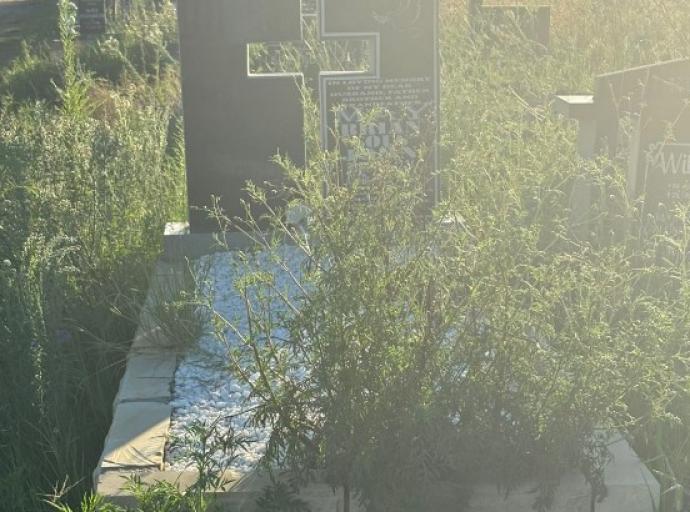
The Heather Heights Cemetery in Bloemfontein, Free State, a site steeped in the painful history of the South African War, has become the centre of growing frustration among residents who say the resting place of their loved ones has fallen into neglect.
The cemetery, which commemorates victims of concentration camps and other conflicts from that era, has long served as a place of remembrance. Today, however, many families say it has become difficult to even locate graves due to overgrown grass, vandalism and poor maintenance.
Residents have taken to social media and raised complaints with Ward 47 councillor Jan-Rudolf Maartens, hoping action will be taken. Many question why they continue to pay rates and taxes while the cemetery remains poorly maintained.
Some graves, particularly older burial sites without tombstones, have been swallowed by thick grass, making access nearly impossible.
In 2022, workers from the Public Employment Programme (PEP) briefly cleaned and cut grass at the cemetery following the ANC’s Letsema clean-up campaign.
During a visit to Bloemfontein at the time, President Cyril Ramaphosa said the campaign aimed to restore the “City of Roses” to its former glory and improve the cleanliness of municipalities across the country.
ANC Ward 16 councillor Logan Kruger welcomed the clean-up initiative, saying cemeteries hold deep sentimental value for communities.
“This is the project that speaks to the community,” she said at the time, adding that residents from her ward also have loved ones buried at Heather Heights.
Kruger explained that 29 people from each ward were selected to work under the programme.
However, concerns about the cemetery have resurfaced. During a recent oversight visit with Maartens, the councillor said the state of the cemetery reflects broader challenges facing the Mangaung Metropolitan Municipality, which manages parks and cemeteries in Bloemfontein.
Maartens said the parks and cemeteries department is severely under-resourced, with only one tractor serving the entire city.
“During my last oversight visit on 4 November 2025, the municipality did clean up after we raised the issue, but they lack the capacity for regular maintenance,” he said.
He added that while Expanded Public Works Programme (EPWP) workers can assist, they cannot replace the municipality’s responsibility to maintain public facilities.
Security at the cemetery is also a concern, with vandalism continuing to plague the site. Maartens said discussions are underway with neighbourhood watch groups such as Rykmanshoogte and Opkoms to explore alternative safety measures.
He also suggested public-private partnerships as a possible solution, including grant-in-aid funding for non-profit organisations to adopt and maintain the cemetery.
Residents are encouraged to continue reporting issues through the proper municipal channels while efforts are made to find lasting solutions.
I was chatting with a friend, more like a Grootman I deeply respect, from the Eastern Cape, over a glass of something, when it suddenly dawned on me that there is something profoundly unsettling about the way we speak about our province.
In the middle of our conversation, he paused and said, “Ngwana mobu, why do you people in the Free State speak about yourselves like you are some colossal failure?”
I laughed. But it was not a comfortable laugh.
Because he was right.
We seem to have developed a strange culture of self-sabotage in this province. We wake up in the morning and even before we greet the sun, we have already told the whole nation that we are useless. That we are corrupt. That we are incompetent. That nothing good ever comes out of here except corruption, mismanagement and division. We have normalised speaking badly about ourselves.
Recently, President Cyril Ramaphosa, in his reply to the State of the Nation Address debates, went out of his way to commend this province. He spoke about how the Free State is leading in taking integrated government services directly to the people. He said it publicly and even urged other provinces to learn from what is being done here.
But did you see it trending? Did you see it leading WhatsApp headlines? NO
Because that story does not feed our addiction to outrage. We prefer the headline that screams: “So-and-so did this!” or “Scandal erupts!” We dissect failure with the sheer enthusiasm of Sunday chisa nyama gossipmongers.
When something goes wrong, we magnify it until it looks like the collapse of Mount Everest. When something goes right, we treat it like a suspicious accident.
This is not to say we must hide wrongdoing. No. Accountability is oxygen for any democracy. But there is a difference between accountability and self-hate. There is a difference between constructive criticism and public self-mutilation.
If you constantly tell investors, tourists and even your own children that your home is a hopeless place, do not act surprised when they pack their bags and leave.
Imagine inviting guests into your house and before they sit down you announce: “Just so you know, this place is a mess. The roof might fall. The food is probably terrible.” Even if the roof is solid and the food tastes good, they will eat nervously.
That is what we are doing as a province.
We are the only people who can turn a compliment from the President into loud silence but turn a beerhall gossip into a public holiday. And so, my grootman concludes with something profound between sips: “You people want to be taken seriously, but generally you do not take yourselves seriously.”
And it struck me.
You cannot build a province with a defeated psychology. You cannot mobilise society if your dominant narrative is that you are doomed.
The Free State is not perfect. No province is. Not even the ones that pretend to have better resources and governance. But there is work being done. There are clinics operating. Roads being repaired. Schools functioning. Integrated services reaching rural communities that, for decades, were forgotten.
Yet our loudest megaphone is reserved for scandal.
We enjoy dragging ourselves in public and then wondering why nobody invites us to a serious table of equals. A province is also a story. And the story we tell about ourselves shapes how others see us. More importantly, it ends up shaping how we see ourselves.
We must correct what is wrong, yes. But we must also celebrate what is working. We must develop the political maturity to hold two truths at once; that we have challenges and that we are making progress. Otherwise, we will be doomed as a province.
And people will continue to laugh at us not because they are undermining us, but because they cannot respect people who always insist on diminishing themselves.
Perhaps it is time we change the story.
•••••
Tshediso Mangope moonlights as a social commentator in his spare time and writes in his personal capacity…
The views expressed do not necessarily reflect those of this publication (Journal News).
Former President Thabo Mbeki has joined thousands of mourners in paying tribute to Anti-apartheid veteran and former Free State Premier, Mosiuoa 'Terror' Lekota, the founder of Congress of the People, who died at the age of 77.
Lekota passed away in a Johannesburg hospital in the early hours of Wednesday morning after a prolonged battle with ill-health.
Below is Mbeki’s full statement
STATEMENT OF THE THABO MBEKI FOUNDATION ON THE PASSING OF MOSIUOA "TERROR" LEKOTA
It was with immense sadness and a deep sense of loss that the Thabo Mbeki Foundation received the news of the passing of Mosiuoa Lekota, a fearless son of the soil who gave the greater part of his life to the cause of freedom, justice, and the dignity of all South Africans.
There are lives so fully given to a cause that when they end, one feels the tremor in the foundations of the house they helped to build. Such was the life of Mosiuoa Lekota.
The German playwright and poet Bertolt Brecht wrote, "There are those who struggle for an hour and that is good. There are others who struggle for a year and they are better.
There are those who struggle many years, and they are better still. But there are those who struggle all their lives: these are the indispensable ones."
This quotation perfectly captures the life and times of "Terror" Lekota. He belongs to that rare category of individuals who gave absolutely everything to the struggle of the South African people. His life was the very embodiment of selfless dedication to freeing his people from the yoke of apartheid oppression. It can be said without fear of contradiction that our victory over that brutal system would not have been possible without the unwavering commitment of indispensable patriots like him.
History demands much of those who dare to confront it, and Mosiuoa Lekota answered that call at every critical turn in our nation's journey. He threw himself against the brutal machinery of apartheid with relentless force. Yet, he also possessed the quiet discipline required to forge a new, inclusive South Africa when the time finally came. His conviction never wavered. Whether he was sparking the militant energy of the youth and student movements or bearing the heavy responsibilities of executive leadership in our new republic, his dedication remained an unbroken thread.
The truest measure of a patriot is frequently revealed not under the bright lights of public office, but in the agonizing, quiet confines of solitude. Behind the cold stone of Robben Island, stripped of his liberty and isolated from his family, his vision for this country never withered into cynicism. Instead, it deepened. We are sharply reminded of the poignant words he penned to his young daughter from his prison cell.
It was a declaration that captured the very heartbeat of the struggle:
"Above all then, my dear, I am in prison for the sake of peace for our country and the world. I am in prison so that our generation may leave to yours and later generations a country and a world that has the greatest potential for progress."
This clarity of purpose was the bedrock of his sacrifice. He surrendered his own youth and endured years of subsequent trials and detentions so that future generations might inherit a land unbound by racial supremacy. When he repeatedly emerged from the crucible of the apartheid prison system, he did not seek sanctuary or rest. Recognising the fierce urgency of the moment, he threw himself entirely into forging broad united fronts against white minority rule. He understood implicitly that the architecture of freedom requires both relentless resistance and radical unity.
As we navigate the contemporary complexities of the democracy he bled to secure, we must resist the temptation to consign his legacy to the archives of history. To appropriately honour Mosiuoa Lekota is to actively defend the democratic institutions he helped birth. We are challenged to ensure that the "potential for progress" he envisioned in the dark of his cell translates into tangible dignity and economic inclusion for all South Africans today.
To the Lekota family, to his wife Cynthia and his children, and to all who loved and admired him, the Thabo Mbeki Foundation extends its heartfelt condolences. We share in your sorrow. In losing Mosiuoa Lekota, we have lost a patriot, a principled leader, and a soldier of the people.
Robala ka kgotso, Ntate Lekota. The country you fought so hard to free will not forget you.
Messages of condolence are pouring in from across South Africa’s political spectrum following the death of veteran anti-apartheid campaigner and Congress of the People (COPE) founder Mosiuoa “Terror” Lekota. Lekota died at a Johannesburg hospital on Wednesday after a long illness.
He was 77. Lekota, a co-founder and President of COPE, was widely respected for his decades-long contribution to the struggle against apartheid and his role in South Af rica’s democratic Parliament. Democratic Alliance (DA) leader John Steenhuisen described Lekota as a principled leader who dedicated his life to serving the country.
“He contributed immensely in our democratic Parliament and remained a steadfast advocate for constitutionalism, accountability and the rule of law. This cost him more than many realise,” Steenhuisen said.
“He could have been a lifelong cadre and beneficiary of patronage. All he had to do was keep quiet. But he chose a different, more difficult path. He showed ccourageand inspired many, including myself and many of my DA colleagues.”
The African National Congress (ANC), where Leko ta played a significant role during the struggle before later leaving the party, described him as a leader who helped shape the country’s history. ANC spokesperson Mahlengi Bhengu said Lekota’s passing coincides with significant milestones in South Africa’s democratic calendar.
“As we commemorate the 30th anniversary of the Constitution and Human Rights Month, we state unequivocally that Lekota has an indelible footprint in these milestones,” Bhengu said.
The Economic Freedom Fighters (EFF) also paid tribute to the veteran politician, acknowledging the role he played in both the liberation struggle and in sshapingdemocratic opposition politics. “His political life reflected both the unity forged in the struggle against apartheid and the divisions that later emerged over the direction of the country,” said EFF spokesperson Sinawo Thambo.
Who is Lekota Mosiuoa Patrick “Terror” Lekota was born in KrKroonstadnd became politically active at a young age. His activism earned him the nickname “Terror”. He was imprisoned on Robben Island for eight years for his role in the struggle against apartheid and later emerged as a prominent political leader. Lekota was associated with the Black Consciousness movement and served as a leader of the South African Students’ Organisation (SASO).
He later became a senior figure in the United Democratic Front (UDF) and was among the accused in the historic Delmas Treason Trial following the Vaal uprising of 1984. After the advent of democracy in 1994, Lekota served as the first Premier of the Free State from 1994 to 1996.
He later chaired the National Council of Provinces (NCOP) and served as Minister of Defence between 1999 and 2008 under former president Thabo Mbeki. In 2008, he left the ANC and co-founded the Congress of the People (COPE), where he served as party president. Lekota will be laid to rest in Bloemfontein. His family has yet to announce the details of his funeral.
South Africa’s fight against Foot-and-Mouth Disease (FMD) is intensifying, with Minister of Agriculture John Steenhuisen closely overseeing the arrival and rollout of vaccines across the country as part of the government’s strategy to contain the outbreak.
The campaign has focused heavily on the hardest-hit provinces, particularly KwaZulu-Natal’s Mooi River region and parts of the Free State. Government efforts include the delivery of large vaccine consignments, a nationwide vaccination programme, and the strict enforcement of disease-control measures.
On Monday, 2 March 2026, Steenhuisen visited a farm just outside Bloemfontein alongside Free State MEC for Agriculture Elzabe Rockman, where he monitored the vaccination rollout and engaged with veterinary teams working on the ground.
The minister said the government is maintaining tight control over vaccine distribution to ensure the programme’s success and to help South Africa maintain its FMD-free status. Authorities have set an ambitious target to vaccinate 80% of the national herd and reduce FMD cases by 70% by December 2026.
“I am deeply impressed by the response here in the Free State, as well as the professionalism and dedication of the veterinary services,” Steenhuisen said.
“Last year, we adopted a new strategy that moves away from chasing outbreaks across the country to a proactive approach of vaccinating the entire national herd.”
Meanwhile, Rockman said the Free State Department of Agriculture has intensified awareness campaigns to educate farmers and communities about the disease and the importance of biosecurity measures. The province now releases weekly updates on infection rates, suspected cases and affected areas, while also hosting community engagements and information sessions focused on prevention.
“FMD has become the central topic of awareness and education in our engagements,” Rockman said.
“The more people understand the symptoms and the strict biosecurity measures required, the better our chances of containing the disease.” She added that collaboration between government, farmers, and communities remains essential to protecting the agricultural sector.
“By working together, we can gain control over the FMD outbreak and move agriculture towards a more prosperous, economically viable and sustainable future for all farmers in the Free State — commercial, communal and small-scale alike,” Rockman said.
Steenhuisen stressed that defeating the disease will require a collective national effort.
“It can’t just be the Department of Agriculture or the farming sector alone. It requires all of us, including active citizens who act as the eyes and ears in their communities,” he said.
“It is only through maximum compliance with the law and biosecurity measures that we will ultimately beat Foot-and-Mouth Disease in South Africa.”
Despite progress in the vaccination drive, authorities acknowledge that the battle against FMD is far from over. However, officials remain confident that sustained collaboration and strict control measures will eventually bring the outbreak under control.