Free State Targets Surgical Backlogs
The three-day Cataract Marathon, held over the weekend at Boitumelo Regional Hospital in Kroonstad, was a great success, with over 100 patients receiving treatment.
Screening was conducted last week Friday with cataract operations scheduled for Saturday and Su...
This time last year I received a hoax that Mosiuoa “Terror” Lekota had passed away.
I found myself frantic, making midnight phone calls trying to verify the information that had just landed in my DM.
The person who sent me this text went mum when I asked why no one is talking about this, why am I not seeing anything in the news, and to this day, I am still wondering what their motive was for spreading such a big lie.
The journalist in me wanted to break the news, but I could not because something about this text was dubious.
This was a cruel reminder of how misinformation can spread and cause unnecessary misery.
Hi everyone my name is Refilwe Mochoari, tomorrow marks the real funeral of Mr Mosiuoa Patrick “Terror” Lekota, a man whose name is engraved into South Africa’s political history.
He passed away last week in a Johannesburg hospital at the age of 77.
Lekota will be laid to rest at his home in Bloemfontein.
His nickname “Terror” was earned not in politics, but on the soccer field. He was fierce in every role that he occupied.
His political history was extremely complex and came with a lot of controversy. Some loved him, some hated him.
Some described him as a traitor, some called him a bully but many respected him.
The people of the great Basotho homeland in the Eastern Free State Qwaqwa downright hated him.
But regardless of all the opinions that come from different people, his presence could not be ignored.
I would like to reflect on his legacy and his leadership style.
Let’s talk about how Mr Lekota was able to write his own terms and conditions throughout his political career.
A freedom fighter, an apartheid activist, and the first Premier of the Free State province between 1994 and 1996.
Lekota’s leadership style was complex, he was a bold, unapologetic leader who fought for what he believed in.
For me, Lekota’s leadership style is a lesson in conviction and resilience.
He was not afraid to take tough stances. He was not afraid to challenge the status quo even if it meant ruffling feathers.
What do we, as individuals, take away from Terror Lekota’s leadership style?
For me, the lesson lies in the duality of leadership, it is both admired and criticized.
Leaders are human, and their legacies are often contested.
Mr Lekota’s story reminds me that leadership is not about perfection, but it is about impact and the ability to stand firm in one’s convictions, even when it is unpopular.
He played leadership roles in the United Democratic Front.
After democracy he became the first premier of the Free State province, he was the chairperson of the National Council of Provinces (NCOP), he was the ANC national chairperson between 1999 and 2008 and he was the Minister of Defense under the leadership of President Thabo Mbeki.
In 2008 when President Jacob Zuma came into power, he alongside his comrade Mbazima Shilowa launched the Congress of the People (COPE), a party which he led until he died.
His involvement and role in all these organisations show his ability to adapt and lead in different contexts.
What I take away from Lekota’s legacy is the importance of staying true to one’s values, ethos, and being willing to take risks.
For me, Lekota’s legacy serves as a reminder that leadership is about making tough decisions and standing by them even in the face of criticism.
As we bid farewell to Terror Lekota this week, I think we should reflect not only on his political journey but also on the broader lessons of the type of leadership role he possessed.
I look at Lekota’s journey and it forces me to think critically about the kind of leaders we want to follow and the kind of leaders we aspire to be.
Leadership offers a path that balances conviction with compassion and vision with inclusivity.
Leadership should help us build a future.
Leaders should not be feared, but they must be respected and most importantly they must be trusted.
The hundreds of people from different political parties including his original political home the ANC over the past two weeks who have paid tribute to Lekota through messages of condolences, through the attendance of his memorial services, the attendance of his funeral tomorrow as well as the South African President Cyril Ramaphosa is an clear indication that one must always stick to their values even if it is not popular.
May the soul of Mr Mosiuoa “Terror” Lekota rest in eternal peace and power.
Frustration is boiling over in Mangaung’s student neighbourhoods as a growing housing crisis pits students, residents, landlords and the municipali ty against each other. Students accuse landlords of charging premium rents for unsafe and overcrowded rooms. Residents blame the spread of informal student housing for ris ing crime and failing services. Landlords, meanwhile, point to weak municipal oversight, while the munic ipality itself now faces claims it allowed the situation to spiral out of control. What began as a shortage of student accommoda tion has evolved into a full-blown urban conflict — brought sharply into focus during the recent Safer City Indaba in Bloemfontein, where safety, infrastructure failures and law enforcement challenges dominated discussions. At the centre of the debate is Mangaung Executive Mayor Gregory Nthatisi, who on Thursday (12 March) convened landlords, officials and other stakeholders in an effort to restore order to the city’s rapidly ex panding student accommodation sector. His message was clear: the era of unregulated stu dent housing is coming to an end. “We cannot allow profit to come before safety. Com pliance is not optional,” Nthatisi told accommodation providers during the engagement, which followed mounting complaints about overcrowding, crime and deteriorating living conditions in student-dense neigh bourhoods. Students Paying More for Less Bloemfontein — home to the University of the Free State, Central University of Technology, Motheo TVET College and several private colleges — has seen a steady increase in privately owned student accom modation as institutions struggle to provide sufficient on-campus residence space. While the shortage has created a booming rental market, students say it has also opened the door to exploitation. Tenants report paying high rents for rooms in con verted houses plagued by poor sanitation, unreliable electricity and blocked sewer systems. Others de scribe overcrowded buildings, a lack of security and slow responses to maintenance problems. “We are paying as if this is luxury housing, but we live with broken toilets, leaking pipes and no safety,” said one student living in privately run accommoda tion near campus. Some students also claim that when incidents oc cur, police response times are slow, forcing residents to rely on private security companies or neighbours for help. Residents Say Neighbourhoods Are Under Pres sure Long-time residents in suburbs with high student populations — including Universitas, Brandwag, Blo manda and Hillside View — say the rapid growth of student accommodation has transformed once-quiet streets into overcrowded areas marked by increased traffic, noise and safety concerns. Illegal building conversions, backyard structures and poorly maintained properties are among the most common complaints. Residents accuse both landlords and the municipality of failing to enforce bylaws. Some community members argue that parts of the city now resemble informal settlements operating un der the label of student accommodation. “These places are not proper residences anymore,” one resident said during the meeting. “They are over crowded buildings with no control, and nobody takes responsibility.” Landlords Defend Their Role Accommodation providers reject claims that they are solely responsible for the problem. Many argue that they stepped in to fill a gap left by universities and government, investing in properties to house students who would otherwise have nowhere to live. They also point to rising operating costs, delayed payments from student funding schemes and complex municipal processes as obstacles to full compliance. “Landlords are expected to provide housing, but the rules keep changing and the municipality does not always offer support,” said Universitas-based student housing provider Bongani Mazwi. Mazwi said landlords are willing to comply with reg ulations but require clearer guidelines, faster approv als and consistent enforcement. Several landlords also questioned whether weak municipal oversight allowed unsafe accommodation to operate for years without intervention, accusing the municipality of “looking the other way”. Municipality Promises Crackdown Concerns raised during discussions linked to the Safer City Indaba highlighted deeper problems in the city’s regulatory system. Broken streetlights, damaged roads, sewer spillag es and unreliable municipal services in student areas have raised doubts about the municipality’s ability to monitor the rapidly growing accommodation market. Critics argue that poor enforcement allowed unlaw ful building conversions, overcrowding and non-com pliant properties to flourish. Nthatisi acknowledged the concerns but rejected claims that the municipality deliberately ignored the problem.“We accept that enforcement has not always been strong enough, but that is exactly why we are acting now,” he said. The mayor confirmed that the city will intensify inspections, require proper registration of student accommodation and strictly enforce health, fire and zoning regulations. Properties that fail to meet required standards could face penalties or closure. Nthatisi said the municipality also plans to work closely with the University of the Free State, law en forcement and community organisations to monitor conditions in student-heavy areas. “This is not about shutting people down,” he said. “It is about making sure students live in safe condi tions and residents feel secure in their neighbourhoods.
Premier leads Thuntsha Lerole programme delivering houses, a new library, farmer support and relief for vulnerable residents
Residents of the Rustenburg Local Municipality breathed a sigh of relief as North West Pre mier Lazarus Mokgosi led the final segment of the Thuntsha Lerole Phase 5 Accelerated Service Delivery Programme, reinforcing the provincial government’s commitment to fast-tracking service delivery and bringing government services closer to communities. Phase 5 of the programme, launched in August 2025, marks a strategic continuation of the prov ince’s efforts to deliver integrated services, tack le long-standing service delivery challenges and strengthen public participation in governance. On 6 March, Mokgosi and members of the pro vincial leadership officially opened the Tshukudu Library in Ward 45 and handed over RDP houses to beneficiaries in the Thekwane area. The premier also handed over two addition al houses in Bokamoso, advancing government’s drive to expand access to housing and restore dig nity to communities through improved living con ditions. Meanwhile, the province is stepping up efforts to combat the spread of Foot-and-Mouth Disease (FMD), which has affected several parts of the country. A vaccination campaign is already under way, with vaccinations administered and informa tion sessions conducted for farmers in the Mid delkraal area. The campaign forms part of broader efforts to accelerate vaccine roll-outs, strengthen coordina tion of funding and support farmers in protecting animal health and safeguarding the agricultural economy. As part of initiatives supporting education and learner wellbeing, 200 sanitary towels were distrib uted to learners at Areaganeng Secondary School, while school shoes were handed to learners from disadvantaged families at Marikana Primary and Kroondal Primary schools. The provincial government also delivered food parcels to vulnerable households in Wards 32 and 33, ensuring support reaches the most disadvan taged residents. Environmental sustainability formed part of the programme, with tree-planting activities conduct ed at the Masakhane Home-Based Care centre and at newly handed-over RDP houses. The programme concluded with an interactive community feedback session at Braampie Sports Ground in Marikana, although proceedings were briefly disrupted by rainy weather. With the completion of Phase 5 of the Thuntsha Lerole Accelerated Service Delivery Pro gramme, attention now turns to whether the North West provincial government will soon roll out Phase 6. With Phase 5 of the Thuntsha Lerole Accelerat ed Service Delivery Programme now concluded, the North West provincial government says the initiative continues to play a critical role in taking services directly to communities. Residents welcomed the delivery of housing, social support and agricultural assistance, while attention now turns to whether the province will soon roll out Phase 6 to sustain the momentum of bringing government closer to the people.
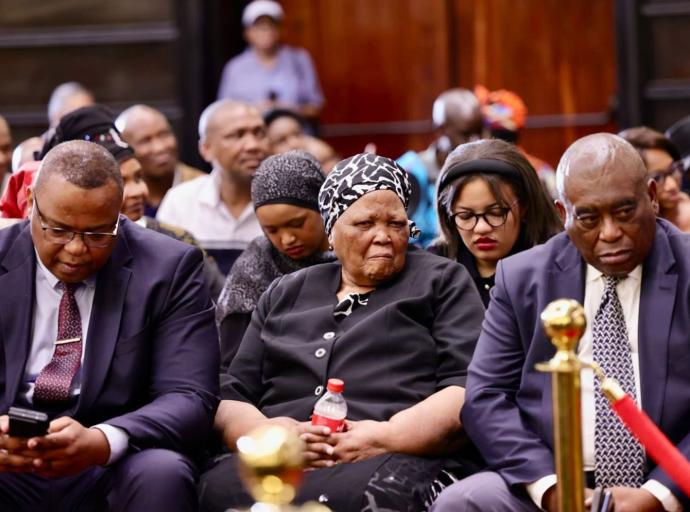
The Bloemfontein City Hall was filled to capac ity yesterday as the nation paused to honour a fallen political baobab. The atmosphere was solemn yet unifying as friends, family, freedom fight ers, and politicians gathered to pay tribute to the late revolutionary, Mosiuoa ‘Terror’ Lekota. A revered anti-apartheid behemoth and seasoned politician who believed the strength of a nation lies in the unity of its people, Lekota passed away last week Wednesday at the age of 77 following a prolonged illness. The former Free State Premier - the province’s first Premier in post-apartheid South Africa - was hailed as a liberation stalwart and a non-racial leader. He belonged to a rare generation that resisted being vic t ims of the apartheid regime and fought for a demo cratic future. Beyond his public life, Lekota was described as a jo vial family man who always prioritised his loved ones. His family remembered him as a figure of warmth who balanced his political duties with genuine affec t ion. “He was always a present father within the con straints of his political career, even through hard ships, he played that role with so much adoration. He was committed and made sure that when he was home, there was warmth and love,” shared Lekota’s niece, Alice Pula. Pula noted that Lekota carried the struggles of the co-existed peacefully. Executive Mayor of Mangaung Metropolitan Municipality, Gregory Nthatisi, noted that Lekota also suffered the family separations that were quite common under apartheid. people in the same heart that carried his family. She added that his passing is a painful loss that has left their hearts shattered. The family has vowed to pre serve Lekota’s teachings and walk in his footprints to ensure his legacy is never abandoned. Lekota was further honoured by comrades who walked the difficult path of the anti-apartheid strug gle alongside him. These peers remembered how he consistently upheld the fundamental objectives of the liberation movement. From the era of repression to the shaping of a new South Africa, Lekota remained committed to the op pressed masses. Professor Itumeleng Mosala, a veteran of the Black Consciousness Movement (BCM) of Azania, shared memories of Lekota’s youth. He noted that he could not remember a time when Lekota was away from the political arena. “I’ve never known a time when Lekota was not in politics. He is a lifetime politician, I have never known him to work anywhere else except in politics,” Mosala remarked. He recalled the period when many leaders were imprisoned on Robben Island or forced into exile in neighbouring and distant countries. Mosala explained that they were not merely organ ising parties or organisations during that era. Instead, they were also focused on organising the minds and souls of black people to achieve true liberation. Lekota is widely regarded as the father of the ‘free’ Free State who envisioned a country where everyone “We are here talking about someone who refused to be a victim of apartheid, someone who, like many others, suffered the separation of the husband from wife, children from parents, and families going in dif ferent directions,” he said. Nthatisi reminisced about Lekota’s integrity, recall ing a time when he discovered corruption and con sulted the community on how to proceed. This trans parency showed his continued intentions to serve the people with honesty. The Mangaung mayor also highlighted that Lekota was among those sent to Robben Island for his activism in 1974. This followed his work as an organiser for the South African Students’ Organisation (SASO). Among the notable attendees was businessman and anti-apartheid activist, Tokyo Sexwale, who also spent years on Robben Island. Sexwale shared that seeing Lekota succumb to illness was a heartbreaking experience for those who knew his strength. “We speak with mixed emotions, it’s not about merely how he lived or what he died for, but it is about us learning from the examples of his methods and the method of his example,” Sexwale told the mourners in Bloemfontein. He warned that the poor in South Africa are de scending further into grinding poverty, while corrup t ion continues to rise, while lamenting that it is be coming increasingly difficult to distinguish between personal pockets and public funds. Lekota served the African National Congress (ANC) until 2008 when he broke away to establish the Con gress of the People (COPE). He served as the presi dent of COPE from its formation in December 2008 until his death. Speaking on behalf of the party, Member of Par liament, Pakes Dikgetsi, described Lekota as a man who sacrificed his freedom for the country. He also recalled that Lekota was still a young student when he first stood up against injustice. “The life of Mosiuoa ‘Terror’ Lekota was not ordi nary - it was a life lived in the service of something greater than himself … the freedom, dignity, and democratic future of South Africa,” he said. Dikgetsi stated that when a towering baobab falls, the earth trembles, and when a leader like Lekota falls, the nation must pause. He believes that through leaders of Lekota’s calibre and stature, the public is instinctively aware that they are reflecting on a gen eration that gave its youth and life for others. The people who served and fought side by side with him encouraged South Africans to act on the values he stood for. They reminded the crowd that he was a national leader who did not merely serve for political brand ing. Lekota will be honoured with a Special Official Cat egory 2 funeral tomorrow, 14 March 2026, in Bloemfontein.
Mosiuoa Lekota first born son of Mapiloko Meshack Lekota and Mamosiuoa Aphaphia Lekota (nee Setai) was born and brought up in an extended family set up, he embraced the structure, culture and family value system that raised him, to his paternal and maternal family Mosiuoa was a very loving, kind, bubbly personality and a great sense of humour. He displayed his leadership qualities very early on in his life and was very intelligent and committed to his studies, which earned him a bursary to study at Mariazell High School His maternal uncle Moramang David Setai, only brother to his mother had a great influence on him growing up.
The day Mosioua resolved to commit and dedicate his life to a cause greater than his life, to contribute to the fight against the brutal apartheid system and emancipate the marginalised and oppressed masses of his people, marked a turning point in his life. He responded to a clarion call to fulfil a generational mission to achieve political freedom within his lifetime, a mission he dared not fail. The unwavering conviction came at an extreme sacrifice to both his life and that of his family. He was fully cognisant of a possibility of never seeing his family ever again and like Kalushi Solomon Mahlangu, Mosiuoa believed that fighting for this just cause, even if he were to die, his blood would one day nourish the roots of a free and democratic South Africa.
While incarcerated on Robben Island, he asked his uncle Moramang Setai to lead a delegation to the Shange family in KwaZulu Natal Province to ask Cynthia Shange’s hand in marriage. Despite his grim reality of a possible lifelong imprisonment, this did not deter him to commit his love to Cynthia Shange and their first born daughter late Masechaba Lekota. He remained determined to fulfil his role as a husband and father, with the hope of one day reuniting with them and starting a new chapter in his life together with his family.
While in prison he penned numerous letters to his new bride and daughter. Over the years he compiled his letters written to his daughter into a book which was published titled “Letters to my daughter”. . In the book he poured out his love for baby Masechaba, assuring her that he had chosen a path less travelled so that she could live and experience life in a free , non racial, non sexist and democratic South Africa with endless possibilities
Mosiuoa also encouraged his family to pursue education as he believed that it was the key to a better life, Through the ANC while imprisoned on Robben Island he facilitated scholarships for his family, both immediate and extended family members. Masechaba was sent to study at Waterford International High School in Swaziland an institution which became a safe haven for many children of the liberation struggle stalwarts. He also arranged ANC funded scholarships for his sibling Poki Lekota and his first cousin Matshediso Setai (his uncle Moramang’s first born daughter) to further their studies abroad and join his uncle late Dr Bethuel Setai who lectured at Vermont University -USA. He wanted to ensure that the generation that came after him in the family are well educated and can contribute to a better society. Unfortunately, this opportunity was missed as it coincided with the unbanning of the ANC and our uncle Dr Setai had to return home in 1991 after many years in exile.
Like many of our struggle heroes, the many years he spent serving prison terms denied him a stable family life and time to bond with his immediate and extended family. This left his wife Cynthia, to raise their children largely alone.as a single parent. He often expressed regret about not being present during his children’s upbringing and missing many of their important developmental milestones. Another deeply painful moment occurred when the brutal apartheid system denied him the opportunity to bury his younger brother Buti Lekota who passed away in 1988.
Unfortunately, the many years of incarceration and intense political activism also took a toll on a normal married life. When he was released from prison, he remained heavily involved in political work in various roles which required extensive travel across the length and breadth of South Africa and abroad, mobilising political support to overthrow the racist apartheid system.
At the dawn of democracy in 1994 when he was appointed the first Premier of the Free State Province, he invited his cousin Matshediso Setai to join him and live together at the official residence “Free State House” as part of the first family of the Free State. He had already secured a student bursary for Matshediso Setai to study at University of the Free State in 1993 with the sole intension of helping to secure a brighter future for his uncle’s daughter. This was a unique transitional period that offered no reference manual navigating life as the new Provincial first family and we learnt as we went along. However, the friendly staff at the residence made the transition easier and manageable. This period afforded us a unique opportunity to get to know each better and established a special bond as first cousins, especially after my dad’s passing two years later. He took it upon himself to celebrate many milestones in my life and those of my daughter Teboho Setai his niece, in trying to close the void of losing both my parents early in life.
In 1995 his wife Cynthia and their 4 children joined him in the Free State Province. For the first time in many decades, he had a semblance of a normal family life notwithstanding the numerous travels both domestically and internationally that continued take him away from his family
In 1996 he was once again separated from his family when he was deployed to take up the role of the first Chairperson of the National Council of provinces (NCOP) based in Cape Town. He left his wife and children in Bloemfontein, once again leaving Cynthia to carry the responsibility of single parenthood, the role she continued to carry with diligence and resilience. After serving at the NCOP, he was deployed to the cabinet of former President Thabo Mbeki as Minister of Defence, while also serving as the National Chairperson of the ANC. Both these roles demanded a significant amount of his time, requiring him to live between Cape Town and Pretoria.
Mosiuoa was intentional about spending quality time with members of both his immediate and extended family whom he loved dearly. Every opportunity he got, he always shared nuggets of wisdom with the younger generation in the family.
After leaving cabinet in 2008 and co-founding the political party Congress of the People (COPE) he embarked on another chapter in his political journey. This new political home which came with its own demands, once again taking him away from his family as he spent much of his time between Gauteng Province and Cape Town in his role as a Member of Parliament until his health deteriorated and succumbed to death.
The life of a freedom fighter who paid the ultimate price by sacrificing his personal life for the liberation of his people was Mosiuoa Lekota’s albatross which he carried with conviction to his final days. Today his illustrious journey is being celebrated and recognised through a State funeral that honours his lifelong dedication to a just cause. The annals of history shall certainly not leave any blank pages when recording his remarkable contribution.
As a family we bid farewell to a dear son, husband, father, grandfather, brother, cousin, uncle. We say:
“Robala ka kgotso Mosiuoa “Terror” Lekota, mosia motubatsi, setloholo sa matsibolo sa bafokeng ba tshele baha Setai.” till we meet again.
Matshediso Setai writes in her personal capacity as first cousin to Mosiuoa Lekota, broadcast media commentator, developmental communications specialist and an integrated communications and media marketing professional.