Free State Targets Surgical Backlogs
The three-day Cataract Marathon, held over the weekend at Boitumelo Regional Hospital in Kroonstad, was a great success, with over 100 patients receiving treatment.
Screening was conducted last week Friday with cataract operations scheduled for Saturday and Su...
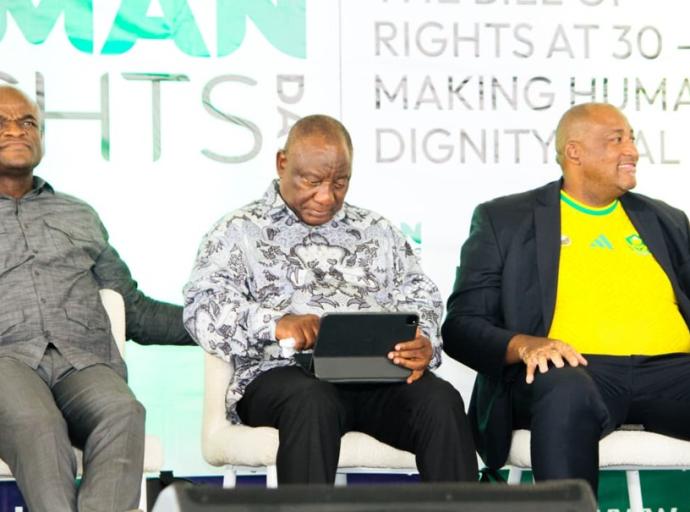
President Cyril Ramaphosa used Human Rights Day to push back against growing criticism, delivering a firm and unapologetic defence of South Africa’s transformation agenda while insisting that social justice and restitution remain non-negotiable.
Thousands of South Africans gathered under the blazing Northern Cape sun as Ramaphosa took centre stage at the AR Abass Stadium in Kimberley on 21 March 2026, delivering a powerful Human Rights Day address that balanced reflection with a firm call to action.
Under the theme "Bill of Rights at 30: Making Human Dignity Real,” Ramaphosa honoured the country’s painful past while making it clear: the fight for dignity, equality and justice is far from over.
Joined by Northern Cape Premier Zamani Saul and senior government officials, Ramaphosa invoked the memory of the Sharpeville Massacre, where peaceful protestors stood against apartheid pass laws. He reminded the nation that Human Rights Day is not just ceremonial—it is a moment to measure progress, confront ongoing injustices, and recommit to the ideals of the Constitution.
“It is fitting that the place that had known so much suffering and tears should be the site from which a new South Africa would rise,” Ramaphosa said, describing the signing of the Constitution as the defining moral commitment of the democratic era. He emphasised that the Constitution remains a living guide toward equality, freedom, and human dignity.
The President highlighted that South Africa’s Bill of Rights stands as the cornerstone of democracy, shaped through one of the most inclusive public participation processes in the country’s history. Yet, despite these achievements, serious challenges persist.
According to findings from the South African Human Rights Commission (SAHRC), key concerns include failures in upholding the rights of accused persons, inadequate basic service delivery, racism, xenophobia, and the growing pressures of climate change. Additional reports point to underspending on housing, strained healthcare resources, and delays in critical services such as foster care grants and access to education.
Still, Ramaphosa pointed to measurable progress in restoring dignity. Millions of South Africans continue to benefit from social support systems, including school nutrition programmes feeding over nine million learners and social grants reaching more than 29 million vulnerable citizens. Access to water, sanitation, and free basic services has also expanded significantly, while hundreds of thousands of students from low-income households are accessing higher education.
He also spotlighted cultural restoration efforts in the Richtersveld, where the Nama language—once suppressed under apartheid—is being revived in schools, symbolising a broader reclaiming of identity and dignity.
Yet his message was unequivocal: progress alone is not enough.
“There can be no peace, no progress without justice,” he said firmly, warning against calls to abandon affirmative action, land reform and employment equity policies. “Restitution is not merely about compensation or redress—it is central to building a just society.”
Ramaphosa stressed that true equality will only be achieved when the economy, workplaces and land ownership reflect the diversity of South Africa’s people. Until then, he said, the mission continues.
“The deliverance of social justice remains our priority,” he concluded. “The progress we have made bears witness to the fruits of our efforts—but the journey is not yet complete.”
A call to honour the sacrifices of the past by creating a future of dignity and opportunities was made by Premier Saul, echoing Ramaphosa’s remarks.
“This is our collective resolve to advance human rights, keep democracy and improve the rights of all our people. Together, let us continue working to build a province and a country that honours the sacrifices of the past by creating a future of dignity and opportunities,” said Saul.
For Ramaphosa, the path forward is non-negotiable: justice, dignity and restitution must remain at the centre of South Africa’s democratic project.
We keep them on the room divider, those family albums. The leather is cracked, the gold lettering has faded to a whisper, but the weight of them is sacred. When we gather, someone pulls one down, and the dust motes dance in the afternoon light.
We open it to laugh at the uncle’s bell-bottom trousers at a wedding in ’85. We pause to sigh over the Christmas where the table was too small for everyone. The album is the vault of us.
But have you ever noticed how, over the years, the (e) pictures alter? Look very closely, a square of yellowed cardboard with four corners of stale glue where a photograph used to be. Someone has been here before us. Someone with scissors, or a firm thumb of irritation towards a perceived “Persona non-grata”, the thumb has decided that specific memory no longer fit the narrative they wanted to tell. Perhaps it was a cousin who left in anger. Perhaps it was a fight that soured a decade of Sundays. The empty space remains, a phantom limb of memory.
This is the dilemma of our public memory. We treat our national story less like the untorn fabric it is, and more like that family album on the room divider, constantly curated by the very last person who felt slighted.
I am reminded of a meeting of the minds and hearts, marriage. Not a political alliance, but letshato ka mpela, in the truest sense of the word. It was a union celebrated under the African sunset, a union that produced children, the synced melody, "tswang, tswanng, le boneng, ngwana o tswana le le coloured" of revolutionary hope. For decades, the family album was full.
Page after page, showed this couple building a home not just a house, weathering all sort of storms both internally and externally, laughing at the kitchen table while the come cover stove warmth’s up the house, and weeping at the funerals of comrades. They raised children together, three very specials offsprings, Freedom Charter, Liberation le National Democratic Revolution. The album was thick with the texture of a shared life.
And as is the way with divorces that turn bitter, the story was rewritten the moment the decree was initiated. The ex, wounded and furious, took the family album and sat down with a pair of scissors. Out came the pictures of the happy years. Out came the memory of the father at the school sports day, the husband nursing the sick child. The narrative was collapsed into a single, devastating phrase wa mobona o “One door in, one door out."
He was no longer the man who had helped build the home but was now the stranger who had just slammed, the door on his way out, irrespective of previous efforts. This was blasted out into the ears of family’s members, friends, to the enemies, to anyone who ever would listen, the story was told anew of a deadbeat, a traitor to the hearth. The rich, complex history of the marriage was replaced with a single, angry snapshot.
Now, that man is today is late. He has gone to the ancestors. And suddenly, the album is brought out again. This time, the tears are for the founding father, the familys own colourful elder. We are told of his immense contribution and his stature within the family and extended reletives. A top of the art funeral, a class befitting of a giant, is dusted off. The tone is one of profound loss, pain is felt through the withheld tears in the corner of the eyes.
The ex speaks of him, but the words are carefully chosen, a eulogy for a stranger, not the complex history of a spouse. We celebrate his departure in recognition, but we refuse to acknowledge the life shared the spouse. We mourn him loudly, but we have already erased him from the family tree. The children of that union, the ideas, the movements, the followers, stand at the funeral and hear a version of their father that bears no resemblance to the man whose pages were torn out. Which story is true?
The tragedy is not that the pages are gone but the painful tragedy is that we are the ones who tore them out, and in doing so, we have erased the only map that could ever show us the way home.
Perhaps, given the chance to reflect, that is the cruellest cut of all history as we shall know it because a map torn to pieces cannot guide your back. It cannot navigate you the path to the meeting place of our kraal when the sun goes down. Now that the family has been scattered, a wedge driven between each member by unresolved personal in my view not ideological, factual or not, but the silence in the album is a deafening verdict. It speaks of a family that has forgotten how to gather.
But as I stare at these empty spaces, I hear the echo of an old voice, a gran’s suggestion from that deep well of wisdom, the glue that holds generations together. She has seen it all; she has been part of this family through its many family battles. She has observed everyone arriving and showing their last respect, irrespective of their own differences, all stood in laughter and celebratory of the life of late spouse. Yes, all in the same proximity. With sheer concern of family value, a painful tear at the corner of her eye, as she often holds it back, asks the question that lingers in the dust: What went wrong?
She asked herself on the golden days, speaking to her own inner person gazing at the sundown that is truly so difficult to forgive each other, for the sake of our children? This hatred, this betrayal, it is destroying us, dissolving the very glue that once held the album together. Why can’t we swallow our pride, just once, and forgive? Why can’t we make peace and move forward?
This unfortunate gathering of the spouse lost, sad it may be, is an opportunity to really teach us something. It reminds us that mohlomong mokete, or perhaps a family reunion, must happen. Not a political rally, but a true gathering to resolve personal matters, for the sake of the clan name and its family values. If we still wish to salvage the reputation of this legacy before it perishes entirely, we must unite every member who went their own way. Ke bohloko ba family; it is the pain of the family that calls out the loudest.
We stand here, staring at the full album and the empty spaces, mourning a man whose pages some tried to tear out. And in the silence, all we can do is whisper the only prayer that fits a family so fractured:
Morena boloka setjhaba, o fedise dintwa le matshwenyeho.
Rest now, old man. You have taught us, finally, that the blank spaces you leave behind are not voids, but a mirror reflecting our own stubborn hearts.
Robala ka kgotso, ho tswa ho rona.
Disclaimer: Thabang Mokoka writes in his own personal capacity
Organized racism, institutional racism, let’s talk about Human Rights Day in modern society.
This year the Bill of Rights marks 30 years and as we commemorate Human Rights Day tomorrow under the theme “The Bill of Rights at 30 – Making human dignity real”, I would like to reflect on how far the nation has come and how far we still have to go on issues of equality and human dignity.
Hi, everyone. My name is Refilwe Mochoari. How long must the generation of today wait until we are all equal in different institutions across South Africa?
On 21 March 1960, the police opened fire on a crowd of about 5000 people in Sharpeville, during a peaceful protest against apartheid pass laws.
On that day, sixty-nine people were killed and 180 were injured.
The Pass Laws Act of 1952 required black South Africans over the age of 16 to carry a passbook also referred to as a “dompas” everywhere and at all times, a system that was used to control the movement of Black, Indian, and Coloured people.
The ‘dompas’ stated which areas a person was allowed to be in, and if they were found outside of these areas, they would be arrested.
Following the Sharpeville Massacre of 1960, several black political parties including the African National Congress were banned by the Nationalist government, which was the governing party of that time, but the liberation movements continued to operate.
On this day, as South Africans, we commemorate the sacrifices that were made by Robert Sobukwe, the founding President of the Pan Africanist Congress (PAC) a breakaway party from the ANC, which initiated the anti-pass laws campaign and led the protest to the Orlando police Station in Johannesburg
We celebrate Philip Kgosana, a university student and PAC member who led the march in Langa Township in Cape Town where over 20 people were killed.
We celebrate Potlako Leballo, Clarence Makwetu, and many other brave young men and women who fought against the ruthless apartheid government.
This day is a symbol of the constitutional promise of dignity, equality, and freedom for all South Africans.
Yet thirty years into democracy the ideals of the constitution remain unevenly realised.
What is the meaning of Human Rights in modern society?
How rife is racism still in the communities that we belong to?
We cannot afford to celebrate freedom while ignoring the persistence of organised racism.
Over thirty years later, it is still difficult for the black and white South Africans to co-exist and really look at one another beyond skin colour.
Organised racism is everywhere and it is rife.
In education, the former model C schools today referred to as quintile 5 schools, black children remain oppressed. These schools remain hostile spaces for many Black learners.
Many black children are abused by their teachers, they are discriminated against, and deprived of opportunities.
These schools foster racist practices and the lack of transformation in these schools affects the well-being of many learners, perpetuating systemic inequality.
In the workplace, black professionals are suffering from corporate inequality. Unequal opportunities and great opportunities are more often than not viewed as Black Economic Empowerment (BEE) placements.
In these institutions, it is so unequal that as a black individual, you have to work twice as hard to prove that you are capable of doing your work.
In residential complexes black occupants and tenants are abused and bullied by the trustees.
To me, Human Rights Day represents a project of unfinished inequality.
Tell me why South Africa still experiences organized racism after so much blood was shed?
A town like Orania a ‘white’s only town’ in the Northern Cape’s Namaqualand district is not an isolated case.
Spending a weekend in this district two weeks ago, was a demonstration that organised racism in South Africa is still in the country.
Driving into that district, I saw an apartheid flag flying with pride on the street poles, and community members of these small towns see it as normal.
What the 69 people of the Sharpeville massacre fought and died for, should be a lived reality and not just cited in the constitution, the speeches, and the government rallies.
The bloodshed during the Sharpeville Massacre, is a call for the invisible “dompas” to be dismantled wherever it hides and it is the duty of government to ensure to fight aggressively.
South Africa cannot afford to ignore organised racism while celebrating freedom.
In 2019 the President of the Republic, His Excellency Matamela Ramaphosa expanded the scope of responsibilities for a department that was originally known to South Africa as Public Works and added Infrastructure. Since then, the call to servitude has come with the recognition that our mandate extends far beyond building roads, bridges, and clinics-it is fundamentally about advancing human rights and ensuring that rural development is tangible, inclusive, and felt in the daily lives of our people.
Across the Free State and the country at large, there is a growing frustration, particularly among the youth, that development remains distant and uneven. This sentiment is justified. Too often, infrastructure delivery has been undermined by inefficiencies, delays, corruption, and a failure to integrate seamlessly with broader developmental programmes.
The result is a gap between policy and lived reality, where access to education, healthcare, housing, and economic opportunity seems like a distant dream, and the promise of human rights is yet to be fully realised in every community.
Our mandate is clear: infrastructure must be the backbone of rural development. More so in a Province considered to be the bread basket of the country wherein every connecting road is significant to the delivery of any and every staple need to the less fortunate. Without the full compliment of infrastructure in rural communities, the most vulnerable, the youth and society at large is disconnected from opportunity and alienated from their full human potential.
As a politician, I view this alienation not only as a social challenge but as a moral and political imperative. Karl Marx’s theory of alienation highlights the estrangement of individuals from their own humanity within hierarchical systems-a reality that resonates in our rural communities, where historical inequities continue to shape access to basic services and opportunities. To truly address the alienation of our citizens, infrastructure must not be delivered in isolation; it must be strategically aligned with human development initiatives, ensuring that investments translate into dignity, mobility, and empowerment.
Infrastructure provision is inseparable from the realisation of human rights. Every school built, clinic upgraded, or road constructed is a step toward ensuring that citizens can access their constitutional rights. When infrastructure delivery is poorly coordinated, it risks reinforcing exclusion rather than alleviating it. We must therefore adopt a human rights-centred approach, where development decisions prioritize the needs of communities, particularly those historically marginalized by race, gender, disability, or geography.
Infrastructure is not simply a technical solution-it is a moral obligation and a tangible measure of social justice. As we broaden our understanding of Infrastructure this Human Rights Day, it is as vital to prioritise access to services through effectively managed and maintained state-used and owned properties. These edifices house government’s machinery, men and women whose rights we are mindful of in our quest to build a capable state.
March 21, Human Rights Day, reminds us that our responsibilities as leaders extend beyond policy documents and budgets. It is a day to reflect on the tangible impact of our decisions on the lives of ordinary South Africans. Whether a young artisan whose life has been greatly altered by the permanent employment recently received through some of the departmental programmes or the children of Xhariep who will benefit from the recently completed Orangekraag Combined School, every decision must be a strategic brick for the road we are paving ahead of us.
Our rural development programmes must work hand-in-hand with infrastructure delivery, creating integrated, sustainable systems that empower citizens and realize their rights. We are accountable not only to legislation and governance standards but to the people whose dignity, potential, and futures depend on our capacity to plan, deliver, and oversee infrastructure that truly serves them.
Past the commemoration of Human Rights Day, we must reaffirm our commitment: to ensure that every road, clinic, and school is not just built, but strategically placed, effectively maintained, and fully integrated into a development framework that leaves no community behind. Human rights, rural development, and infrastructure provision must operate seamlessly, for only then can we truly claim progress, and only then can our citizens live free from the alienation of the human condition.
About the author
Dibolelo Mance is the MEC for Free State Department of Public Works and Infrastructure
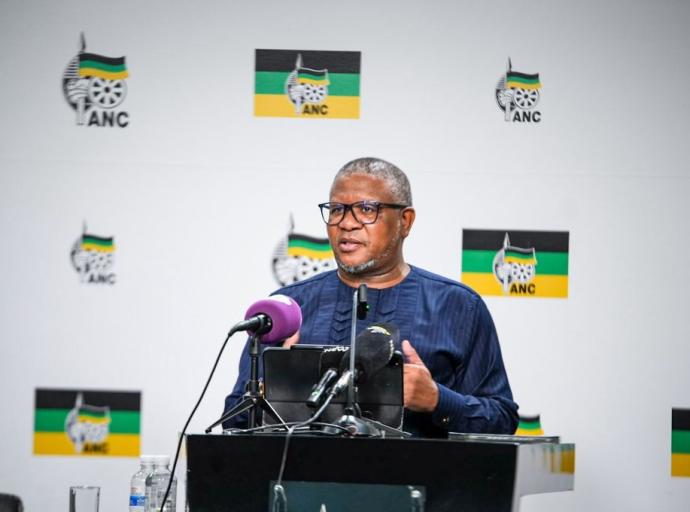
The African National Congress (ANC) has scrapped its planned regional and provincial conferences, opting instead to fast-track the nomination and selection of councillors in a move that signals urgency ahead of looming electoral deadlines.
The decision shifts focus from internal deliberations to candidate processes, with party structures now expected to prioritise branch-level nominations and streamline the selection pipeline to ensure readiness for the upcoming polls.
In a letter addressed to provinces and the party’s electoral committee chairperson, Kgalema Motlanthe, Secretary-General Fikile Mbalula directed party members to officially kick off the selection process of councillors from 1 April, while putting a stop to internal elective conferences.
“This instruction effectively means that all ANC elective conferences at regional and provincial levels must be put on hold from 1 April until immediately after the date of the 2026 local government elections, which is yet to be announced by the Independent Electoral Commission (IEC),” Mbalula said in the letter.
He further ordered that, in line with the selection process, all NEC-approved rules and guidelines must be strictly followed.
“We wish to emphasise that adherence to rules and guidelines approved by the NEC is sacrosanct and deviations of any form shall not be tolerated by the ANC,” he said.
The IEC has indicated that local government elections are expected to take place between November 2025 and January 2026.