Free State Targets Surgical Backlogs
The three-day Cataract Marathon, held over the weekend at Boitumelo Regional Hospital in Kroonstad, was a great success, with over 100 patients receiving treatment.
Screening was conducted last week Friday with cataract operations scheduled for Saturday and Su...
A total of R22.5 million has been committed to support small businesses across the Free State — a figure that signals intent, but also raises a critical question: is it enough to change the economic reality on the ground? At a media briefing, MEC for Finance, Economic De velopment and Tourism Ketso Makume positioned the funding as a strategic intervention to unlock township economies, stimulate growth, and create jobs. The money will be channelled into Micro, Small and Me dium Enterprises (MSMEs), with support ranging from equipment and stock to business expansion and infra structure upgrades. The funding spans multiple sectors — including man ufacturing, agro-processing, construction, hospitality, and informal trade — targeting businesses at different stages of development. Informal traders and spaza shop owners will receive support of up to R100,000, while small enterprises can access up to R250,000. Medium enterprises, meanwhile, are eligible for larg er, expansion-focused funding through co-financing mechanisms. But while R22.5 million appears substantial, the scale of demand tells another story. With 2,034 appli cations received, the funding must stretch across a vast pool of entrepreneurs — many of whom are struggling to stay afloat in a tough economic climate. The bulk of the funding has been directed toward key economic hubs, with Mangaung Metro receiving R13 million, followed by Thabo Mofutsanyana at R6 million. Smaller districts like Xhariep received just over R1 million — a distribution that reflects population and economic activity, but also underscores uneven access to opportunity. Government maintains the funding is more than just f inancial relief — it forms part of a broader ecosys tem aimed at building capacity, boosting productivity, and integrating township enterprises into mainstream value chains. Yet experts warn that without strong oversight, mentorship, and sustained support, even well-funded programmes risk falling short. For many entrepreneurs, the stakes are high. This R22.5 million must now carry the weight of sustaining hundreds of businesses, creating jobs, and driving local economic growth — all at once. Ultimately, success will not be measured by the size of the allocation, but by its impact: thriving enterpris es, meaningful employment, and a more inclusive pro vincial economy. Because in the Free State’s fragile economic land scape, the real test is not how much has been spent — but whether this R22.5 million can truly move the needle.
Northern Cape premier urges drivers to slow down, avoid alcohol and prioritise safety as holiday traffic surges
With the Easter rush looming, Northern Cape Premier Zamani Saul has issued a heartfelt and urgent appeal to motorists — remind ing them that every journey carries the weight of lives waiting at the other end, and that one reckless mo ment can shatter families forever. Speaking ahead of the expected travel surge, Saul painted a vivid picture of the province’s long, unforgiv ing roads — stretches of tar cutting through vast, quiet landscapes, where a single miscalculation can have ir reversible consequences. “Picture a mother waiting at home for her children to arrive safely… a family preparing a meal, expecting laughter and reunion,” Saul said. “Now imagine that same home receiving a phone call instead — one that changes everything in an instant. That is the reality we are trying to prevent.” The Northern Cape’s major routes — including the N12, N14 and R27 — are expected to carry heavy traf fic as families travel between Kimberley, Upington and Kuruman, as well as smaller towns across the prov ince. While these roads may appear calm and open, Saul warned that their very nature often breeds dan gerous overconfidence. “Those long, straight roads can trick drivers into thinking they are in full control,” he said. “But fatigue creeps in quietly. Speed builds without notice. And one second — just one — is enough to change lives forever.” Saul stressed that most crashes are not accidents, but the result of preventable behaviour — including speeding, drunk driving and ignoring basic safety rules. He urged motorists to travel with intention: check vehicles before departure, plan rest stops, avoid night driving where possible, and ensure all passengers are properly restrained. But it was his message on alcohol that carried the most weight. “No celebration is worth a life,” Saul said. “If you are going to drink, do not drive. Make a plan. Protect yourself, your passengers, and every other person on that road.” Law enforcement agencies will be out in full force across the province, with heightened visibility, road blocks and speed checks. Saul made it clear that au thorities will act decisively against those who break the law — but emphasised that enforcement alone cannot save lives. “This is not just about policing,” he said. “It is about responsibility. It is about values. It is about choosing life.” He also highlighted the devastating ripple effects of road crashes, particularly in rural provinces like the Northern Cape, where emergency response times are often longer and access to medical care more limited. “When a crash happens here, the consequences are often more severe,” Saul noted. “Distance becomes a factor between life and death.” In a final, heartfelt appeal, Saul called on commu nities, churches and families to reinforce road safety during Easter gatherings — turning reflection into awareness. “Let this Easter not be remembered for sirens and sorrow,” he said. “Let it be remembered for safe jour neys, for families reunited, for lives protected.” As thousands prepare to take to the roads, the mes sage is clear: slow down, stay alert and arrive alive — because behind every journey is a story worth protecting.
New Free State Top Cop Vows Zero-Tolerance on Corruption, Pledges Accountability and Trust Rebuild.
Newly appointed Free State Provincial Com missioner, Lieutenant General Thabang Lesia, has drawn a hard line in the sand— vowing to root out corruption and restore integrity within the South African Police Service (SAPS) as he moves to rebuild trust between communities and the men and women in blue. Following his promotion by National Commis sioner Fannie Masemola on Monday, Lesia signalled a zero-tolerance approach to misconduct, warning that rogue officers will be held accountable while internal oversight and discipline are strengthened. He maintains that restoring public confidence will depend on visible policing, ethical leadership and consistent engagement with communities across the province. Masemola expressed full confidence in Lesia’s ability to steer the organisation through a turbulent period marked by heightened public scrutiny, par t icularly in the wake of the Madlanga Commission and ongoing engagements within Parliament’s ad hoc committee. in the organisation. However, given your experi ence, your credentials and your deep understand ing of both operational and investigative policing, I have full confidence in your ability to lead the SAPS in this province,” said Masemola. “With your experience as both a seasoned detec t ive and an accomplished operational commander, I am confident in your ability to provide strong stra tegic direction and sound judgment—particularly at a time when crime patterns are evolving and organised crime continues to intensify. The SAPS is navigating a challenging period in terms of public perception. You have followed developments aris ing from the Madlanga Commission and engage ments within the Parliament ad hoc committee. You have felt the weight of public scrutiny—some of it fair, some of it brutal—but all of it significant.” Free State Premier MaQueen Letsoha-Mathae be lieves will work in his favour. Yet, even as Lesia positions himself as a reformer, his appointment is not without controversy. His ten ure as Deputy Provincial Commissioner was cloud ed by allegations of corruption and misconduct raised by whistle-blower Patricia Morgan-Mashale, adding complexity to his leadership profile and rais ing broader questions about accountability within SAPS. Lesia has consistently denied the allegations, describing them in court as fabricated. In 2021, he secured an interim protection order against Mor gan-Mashale and her husband following claims of harassment and defamation. On Monday, however, Lesia struck a firm tone on accountability. “There is no way we cannot have managers, especially at the senior level, who are not accounting for what they’ve been hired to do,” he said. His remarks carry particular weight in a province where leadership failures—both political and ad ministrative—have often gone unchecked, eroding public confidence in institutions meant to serve and protect. Outlining his priorities, Lesia emphasised the need to improve police visibility, service delivery and internal conduct. He made it clear that indiscipline within the ranks would not be tolerated. “We will improve visibility, improve service, and address the conduct of the police,” he said. “We are not going to allow officers to do as they please. Our focus will be on tackling drugs, gang violence, organised crime and corruption—but our biggest ongoing battle remains the spread of drugs in our communities.” With 39 years of service, having joined SAPS as a student constable in 1986, Lesia brings decades of institutional experience to the role—something “I know him… he has been in the system. He is not a new person,” she said, expressing confidence that he “will not disappoint.” But the Premier’s support also underscores a broader reality: policing alone cannot solve the province’s crime challenges. “We need the involvement of communities,” she said. “Police cannot be everywhere.” Ultimately, Lesia’s success will hinge not only on his promises, but on his ability to act decisively and consistently in a system long criticised for failing to hold its own accountable. In a climate of deep scep t icism and rising crime, his leadership will be tested not by rhetoric, but by results. Whether he can truly clean up SAPS in the Free State remains to be seen—but the expectation is clear: the era of impunity must come to an end.
Despite governance failures and internal battles, the Free State secretary says the ANC is on the path to renewal
Despite mounting challenges — from failing municipalities to bitter internal divisions — the African National Congress (ANC) in the Free State is on a path to renewal, with provincial secretary Polediso Motsoeneng insisting the party will soon emerge stronger and revitalised. During a post-Provincial Executive Committee meeting media briefing at the provincial headquarters (Kaize Sebothelo building) on Monday, Motsoeneng said 244 of the 319 branches have successfully elected their branch executive committees. This is despite recent disputes from some branches in the Lejweleputswa region, where members com plained of irregularities and challenges with the party’s membership system. “We acknowledge the challenges that remain, par t icularly the inconsistency of the membership system, which has proven unreliable in qualifying branches based solely on quorum rather than the completion of leadership elections,” he said. He further stressed that, “If REC or PEC members begin to interfere with the pro cess of BGMs, that is a contravention of the laid-down rules. Where it has happened, branches of the ANC have a responsibility to lodge a dispute regarding the participation of those not meant to be part of active proceedings.” The provincial secretary emphasised the PEC’s commitment to finalising the 75 remaining interim structures before the end of the month, saying rebuilding efforts are non-nego tiable. “A functional ANC is measured through its active branches, and we will spare no effort in ensuring that every branch is revitalised, every region is convened, and every structure is accountable,” he said. Regional Conference Plans Hang in the Balance With a bruising contest looming in three of the party’s five regions ahead of elective conferences, provincial secretary Polediso Motsoeneng says no firm dates have been set, stressing that readiness will depend on full compliance with organisational rules. Following the arrival of a second audit report last week from Secretary-General Fikile Mbalula, Motsoeneng confirmed that some regions now qualify to proceed. However, he cautioned against a growing tendency among members to bypass internal processes and rush to court when dissatis fied with outcomes. “We must be meticulous to ensure that every step complies with guidelines, constitutionality, validity and proper procedure,” he said. This comes despite a directive from the party’s National Executive Committee (NEC) that all re gional and provincial conferences be concluded by the end of last month to pave the way for council lor candidate selection ahead of elections. Journal News understands that the Provincial Ex ecutive Committee (PEC) plans to write to Mbalula requesting a waiver for regions deemed ready to proceed. Among them is the Mangaung region, which has reportedly reached the 70% threshold required to convene a conference on 10 April 2026 and elect new leadership. The region has been under a Re gional Task Team (RTT) since last year after the pre vious leadership’s term expired. Key regions Mangaung and Lejweleputswa were initially scheduled to hold conferences in Novem ber last year, but these were postponed due to unresolved organisational processes and internal disputes. Similar irregularities have resurfaced in Le jweleputswa, where some branches lodged fresh disputes last week. The Fezile Dabi region could also proceed before the end of April—pending approval of the waiver— as its leadership term nears expiry in May. Mean while, Thabo Mofutsanyana, the party’s largest region in the province by membership, along with Xhariep, are understood to still be operating within their mandates. Municipal leadership announcement Following last year’s dismissal of seven munic ipal troikas in the province, Motsoeneng said last week’s meeting has moved to finalise the matter, with new mayors set to be announced in the com ing days. “We have received a report from the interview panel, signed off by the Secretary-General. Can didates are currently engaging with Provincial Working Committee officials to finalise details and will meet affected members and their regions this week before the announcement of new leader ship,” he said. The PEC removed seven troikas — mayors, speakers and chief whips — citing poor perfor mance and undermining service delivery. The affected municipalities include Mafube, Mo qhaka, Letsemeng, Nketoana, Nala and Masilonya na local municipalities, as well as the Lejweleputs wa District Municipality. Motsoeneng added that the PEC’s meeting with President Cyril Ramaphosa last week at the Imvelo Safari Lodge placed service delivery at the centre of discussions under the theme: Fixing Local Gov ernment and Transforming the Economy. “The engagement was unequivocal: the quali ty of life of our people is determined at the local level. It is in municipalities where the promise of a better life must be realised,” he said. “We reflected on challenges highlighted in re cent PEC reports, including financial mismanage ment and corruption that have plagued some mu nicipalities, leading to interventions under Section 139 of the Constitution,” he added.
Families claim their autistic children received little to no therapy despite paying over R100 000 in fees
Parents of children with special needs have raised serious concerns about the quality of support and therapy provided at Blaze The Sanctuary Autism Education and Support Centre in Bloemfon tein, alleging their children were denied proper care despite paying substantial fees. Rethabile Moleko told Journal News that she spent thousands of rands hoping her daughter would re ceive speech therapy, but nearly two years later, the child still cannot speak, with too few therapy sessions conducted and no report provided on her progress. Moleko enrolled her daughter at Blaze The Sanctu ary Autism Education and Support Centre when she was two years old after noticing delays in her speech development and believing the facility would provide specialised support. At first, she believed the delay may have been linked to the family travelling fre quently when the child was born. However, when the child reached an age where she was expected to begin speaking and still showed no progress, Moleko decided to leave her with her par ents in Bloemfontein, Free State, while she returned to work abroad. According to Moleko, during the time her child at tended the school, she repeatedly requested updates on the therapy sessions and the progress being made. “I requested documentation to confirm that the sessions had actually taken place. I was provided with incomplete handwritten pencil notes, not the professional therapy records one would expect from a therapist.. “She was enrolled at Blaze and was supposed to receive therapy as part of her support plan. She start ed in 2023 when she was two and a half years old. So for nearly two years, that therapy either did not take place or was not properly administered,” she stated. Moleko revealed that when she raised concerns about the lack of proper documentation, she was met with what she described as unprofessional and aggressive responses. “No parent advocating for their child’s needs should be treated like this,” she said. She claims that several people working at the school informed her that her daughter had received therapy fewer than five times in the last two years, despite the family paying full school fees and addi tional therapy costs that amount to more than R100 000 per year. Moleko also alleges that some teachers at the school are not adequately equipped to work with children who have special needs. “I would receive phone calls almost every day from a particular teacher telling me my child had a melt down, while I was out of the country. I took my child there because they specialise in children on the au tism spectrum,” she said. Another parent, who asked to be identified only as Lydia, said she had a similar experience. She explained that her daughter was diagnosed with autism at the age of three and was later enrolled at the same centre. “A month or two after my daughter started there, I began asking questions about her progress. “Either I was ignored or only received a response three days later. When I asked for feedback within a reasonable time, about a day, the principal called me into her office like a child to be scolded and said I was the problem for asking too many questions,” she claims. Lydia told this newspaper that she felt justified in asking questions because she was paying about R7 100 per month for her daughter’s education. Both parents said they want the school to take accountability for what they believe is a failure to provide the support and education their children re quired and promised. “A new manager, speech therapist, and occupa tional therapist are needed because this is where the biggest problems come from. These individuals are ruining the potential of this school and the future of each autistic child at this school,” said Lydia as the concerned parent. They further claim that the situation has caused trauma for many parents who trusted the school with the development of their children. On the contrary, the principal of the centre, Dr Marinda Raubenheimer, has denied the allegations. She emphasised that the well-being and develop ment of the children at Blaze remains a top priority. “On a daily basis, our staff go beyond what is re quired of them to ensure the centre’s objectives are achieved, and the children are accommodated and cared for in a happy and stable environment,” she said. Dr Raubenheimer also rejected claims that some staff members are not properly equipped to work with children with special needs. “Our staff complement is experienced in working with special needs children and the unique challeng es they face daily. They are dedicated to guiding and supporting the development required by these chil dren. I deny that our staff is not equipped to work with our children.” Raubenheimer added that the centre encourages parents to reopen communication channels so that concerns can be addressed in the best interests of the children. Meanwhile, Charmaine Thaele, a mother to a 13-year-old autistic son, says that it is very hard to find a school for a child with autism, as they have to go through a long process and still be put on a waiting list. “It’s been tough, it still is difficult, I’m unemployed, and there are no schools in Qwa Qwa, which is a huge challenge, only Centers. “There is a process that one has to go through, which involves registering through the department of education, where your child must be assessed by an occupational therapist, then the department’s thera pist, only then they then place your child on a waiting list if he is a candidate for the school they feel match es his needs,” said the distraught mother. She further added that the process takes years be cause these special schools that are subsidised by the government are limited. Thaele says she began the process of registering her son two years ago, and they are still waiting for her son to find placement. “We started the process in 2024. We did everything, still waiting to be called by the school, bear in mind he is still growing, and my fear is when they finally respond, he will be at school leaving age, which is 16. “My son is currently 13, turning 14, and is non-ver bal, so u can only imagine the challenges he faces. As for private institutions, yes, they are available, but cost an arm and a leg,” she added. In an attempt to fight for the rights of children and adults with autism to receive the services they de serve, Thaele runs an organisation called Still I Rise Foun dation, which focuses on stimulation and entertain ment for autistic kids and those who have various disabilities.
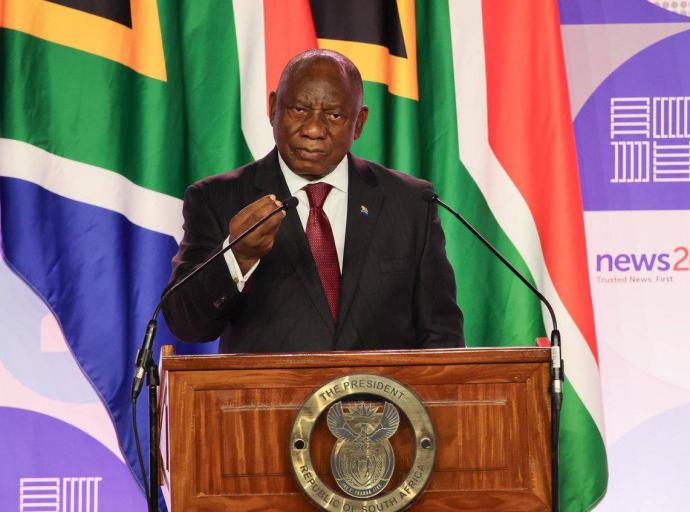
President Cyril Ramaphosa says the government will invest more than R1 trillion over the next three years to modernise and expand South Africa’s public infrastructure.
Speaking at the Sixth South Africa Investment Conference on Tuesday, he said the investment would cover roads, rail, ports, water, energy, and digital projects.
“Over the next three years, the state has budgeted to invest more than R1 trillion or approximately USD 58 billion in modernising and expanding public infrastructure across South Africa,” Ramaphosa said.
He emphasised that R940 billion of the allocation is planned for infrastructure spending, with R375 billion set aside for state-owned companies to maintain, upgrade, and expand their assets.
Highlighting the road network, Ramaphosa said the South African National Roads Agency (SANRAL) would be investing between R300 billion and R400 billion to upgrade and maintain national roads and develop strategic freight corridors.
“Up to R250 billion is being invested in ports and logistics modernisation, driven by Transnet. The Port of Durban is being expanded to handle higher container volumes and improve efficiency, with similar upgrades in Cape Town and Ngqura,” he added.
Passenger rail will also receive significant attention, with about R420 billion allocated to the Passenger Rail Agency of South Africa for corridor reconstruction and rolling stock programmes, as well as to Transnet for network expansion.
Ramaphosa said the water sector would see major investment as well, including projects such as the Olifants Management Model Programme in Limpopo and the uMkhomazi Dam linked to Phase 2 of the Lesotho Highlands Water Project.
He also said energy infrastructure will receive R6.5 billion over the next three years, supporting the Department of Energy’s long-term energy security plans. Other projects include upgrades to OR Tambo International Airport, investments in green logistics, and incentives for electric vehicle infrastructure.
The President singled out the R5 billion investment in the Square Kilometre Array (SKA) radio telescope in the Karoo, which will see the construction of two supercomputers that he said will rank among the fastest in the world.
“This isn’t just a testament to the value of strategic public investment in digital infrastructure; it is also a reflection of South African scientific excellence and world-class scientific research output,” he said.
Ramaphosa also stressed the role of innovative financing in fast-tracking infrastructure development.
“We will be utilising innovative funding models that will reduce risk and attract investors to fast-track infrastructure projects. One of these is the Infrastructure Fund that we established in 2018 out of the need to deploy blended finance to infrastructure development,” he said.
Last year, the fund approved projects worth about R38 billion across water, sanitation, student accommodation, health, energy, and transport.
He added that public-private partnership regulations and instruments such as the Credit Guarantee Vehicle would further de-risk private investment.
Economic transformation and empowerment remained a central theme in his address. “The transformation of our economy is necessary to drive sustained growth, reduce inequality and correct the injustices of the past.
''We are undertaking a review to refine, realign and strengthen our B-BBEE framework to ensure that it supports transformation while at the same time enabling investment and growth,” he said.
Ramaphosa also described South Africa’s empowerment laws as “practical and innovative,” highlighting the Equity Equivalent Investment Programme (EEIP) for multinational companies unable to comply with local B-BBEE ownership requirements.
“Since its inception, the EEIP has onboarded some of the world’s leading multinational firms who have leveraged the programme to direct investment into local development, to incubate black, youth and women-owned businesses, and to fund skills development,” he said.
“Our overriding objective is to support firms with compliance, and to embrace empowerment as a meaningful investment in South African’s long-term economic stability.”