Free State Targets Surgical Backlogs
The three-day Cataract Marathon, held over the weekend at Boitumelo Regional Hospital in Kroonstad, was a great success, with over 100 patients receiving treatment.
Screening was conducted last week Friday with cataract operations scheduled for Saturday and Su...
As the Matric Class of 2025 receives its results, the Mineworkers Development Agency (MDA) extends its sincere congratulations to every learner who has reached this important milestone. Completing matric represents years of dedication, sacrifice and perseverance by young people, supported by families, educators and communities who believed in their potential.
Yet for millions of South Africans, the release of matric results is not only a moment of pride, but also the beginning of uncertainty. In a country facing persistent youth unemployment, deep inequality and critical skills shortages, this moment demands a deeper national conversation about what comes next.
Matric results do not define your economic future
For learners whose results meet their expectations, this is a moment to celebrate and plan the next chapter with confidence. For others, whose marks may not reflect their effort or aspirations, it is important to say this clearly: matric results do not define your worth, your intelligence or your future.
South Africa’s economy requires a wide range of skills, talents and forms of knowledge. Many of these are developed outside traditional academic pathways and through practical, hands-on learning. What matters most at this stage is not a single set of marks, but the courage to reassess, adapt and continue learning.
It is within this context that vocational education, skills development and workplace exposure emerge not as second choices, but as strategic responses to the realities of the labour market.
Why skills-based pathways matter now more than ever
South Africa’s economy remains heavily reliant on labour-intensive sectors such as agriculture, mining, construction, manufacturing, energy and infrastructure development. These sectors depend on artisans, technicians, machine operators, supervisors and skilled workers who are trained practically and can contribute immediately in real working environments.
Vocational training plays a critical role in bridging the gap between education and employment. Unlike purely academic routes, vocational programmes emphasise learning by doing, problem-solving in real-world settings and the development of technical competence alongside workplace readiness.
In agriculture, skills training supports food security, agro-processing and rural development, preparing young people for roles ranging from farm operations and irrigation systems to equipment maintenance and sustainable production practices. In construction and industrial sectors, skilled artisans and technicians are the backbone of housing delivery, infrastructure projects and industrial growth. These industries cannot function without competent, hands-on workers.
Aligning skills with labour market demand
One of the most significant barriers facing young people after matric is the mismatch between qualifications and available jobs. Too many young people are trained for roles the economy cannot absorb, while employers struggle to find candidates with practical technical skills and work experience.
The Mineworkers Development Agency was established by the National Union of Mineworkers. The MDA achieves some of its strategic objectives through partnerships between organised labour, business and government to respond directly to this challenge. Its work focuses on creating sustainable livelihoods for mineworkers, ex-mineworkers and their communities, with a strong emphasis on young people in mining-affected and rural areas.
By prioritising vocational training in labour-intensive sectors and aligning programmes with labour market demand, the MDA contributes to both individual empowerment and broader economic development. Its approach recognises that training alone is insufficient unless it is directly connected to real economic opportunities.
Why experience matters as much as training
Employers consistently point to lack of work experience as one of the biggest obstacles to hiring young people. Qualifications without practical exposure often leave learners unprepared for the realities of the workplace.
The MDA addresses this challenge by integrating workplace exposure, internships, and experiential learning into its skills development initiatives. Through partnerships with accredited training institutions, employers, and community-based projects, young people gain hands-on experience in real working environments aligned to market needs.
At the Marikana Agri Hub, participants are trained in crop and livestock production, agro-processing, irrigation systems, agricultural mechanisation, and basic farm management, allowing them to apply theoretical knowledge directly to operational agricultural settings.
Similarly, the Welkom Digital Hub equips youth with future-focused skills through training in digital literacy, coding and software development, graphic design, digital marketing, data analysis, and ICT support.
This practical exposure builds confidence, discipline, and a clear understanding of workplace expectations qualities that cannot be fully developed in a classroom alone. For many young people, the first opportunity to work with tools, machinery, digital platforms, or production systems is transformative, turning abstract learning into tangible competence, employability, and entrepreneurial readiness.
Empowering youth beyond employment
The MDA’s work extends beyond preparing young people for jobs. Its programmes also promote entrepreneurship, cooperative development and self-employment, particularly in communities affected by mine closures and economic transition.
In areas where formal employment opportunities are limited, vocational skills in agriculture, construction, manufacturing and services can be leveraged to build local enterprises, improve infrastructure and stimulate local economies. This approach enables young people to see themselves not only as job seekers, but as contributors and job creators within their own communities.
A message to the Class of 2025
To the Matric Class of 2025, this is a moment of reflection and possibility. Whether your results open doors to university, college, vocational training or alternative pathways, know that success is not defined by a single route.
South Africa needs skilled hands as much as it needs academic minds. Many of the skills that build this country are learned through practice, perseverance and experience. Vocational training is not a lesser option; it is a vital pathway to dignity, productivity and sustainable livelihoods.
Reimagining pathways beyond matric is not the responsibility of young people alone. It requires deliberate investment by government, industry, training institutions and communities in skills that align with economic realities and national development priorities.
Matric is not the end of the journey. It is the beginning of many roads—and with the right skills, experience and support, meaningful progress remains possible.
African National Congress (ANC) Secretary-General Fikile Mbalula has committed the ruling party to decisive intervention in failing municipalities, assuring residents that urgent steps are being taken to address long-standing service delivery challenges and restore public confidence in local leadership.
This follows the party’s decision to place ailing local government at the centre of its programme for 2026.
Addressing a well-attended Free State January 8 celebration at Caleb Motshabi Stadium in Madikgetla, Trompsburg, Mbalula said fixing dysfunctional municipalities would be the party’s top priority in the year ahead.
“The ANC has never shied away from acknowledging its challenges. We have declared this year as the year to fix local government and the economy. Municipalities will be required to submit service delivery reports every three months to demonstrate that work is being done and that people are receiving services,” Mbalula said.
He issued a stern warning against laziness and corruption within municipalities, urging provincial leadership to take decisive action against mayors who fail to carry out their responsibilities.
“People are complaining about the ANC. The problem is not the ANC but the people the organisation has deployed in municipalities. This year, we say that where there are challenges, they must be fixed. The Free State is leading when it comes to fixing local government and intervening on leadership issues. It is the first province to address ineptness in local government leadership,” Mbalula said.
Last year, the provincial leadership announced the removal of seven municipal mayors, speakers and chief whips, citing persistent audit disclaimers, weak leadership and poor governance, which undermined service delivery. Allegations of corruption were also cited.
Meanwhile, delivering the party’s January 8 Statement at Moruleng Stadium outside Rustenburg last week, President Cyril Ramaphosa said that as the ANC heads towards local government elections, the party will refocus its efforts on strengthening its presence at the local level through improved service delivery.
“We cannot accept dysfunctional, apathetic and uncaring local government. We cannot accept an economy that only works for the few. We cannot bow our heads and accept defeat. Our forebears demonstrated bravery 114 years ago. We therefore declare 2026 as the year of decisive action to fix local government and transform the economy,” Ramaphosa said.
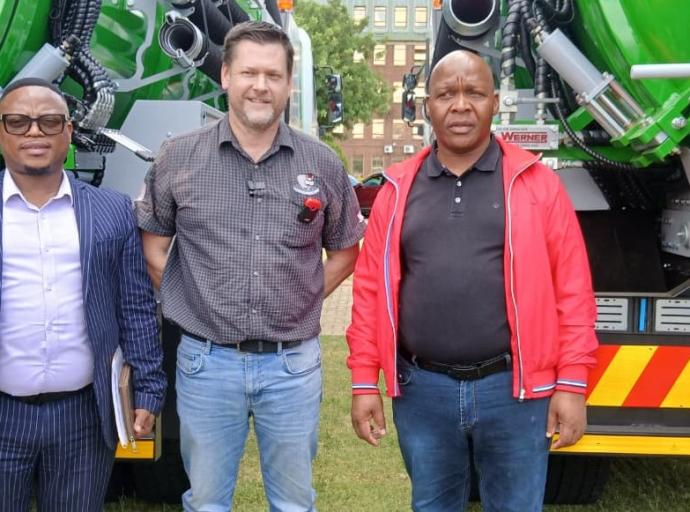
The Matjhabeng Local Municipality has addressed concerns surrounding the procurement of jet vacuum trucks, which have sparked debate on social media amid claims that the municipality exceeded its allocated budget.
On 30 June 2025, the municipality procured two sewer combination trucks following a dual-authorised request from the fleet section. Merafe Holdings, a recognised service provider, was appointed through National Treasury under the RT57 transversal contract.
Acting Municipal Manager Thabo Panyani confirmed that the procurement process fully complied with all prescribed supply chain management requirements and that all relevant documentation was submitted, approved and duly signed.
“Claims circulating on social media suggest that the trucks should have cost the municipality R10.8 million but instead amounted to approximately R20 million,” said Panyani. “These claims are misleading and based on inaccurate quotations sourced from Werner Pumps.”
Panyani further explained that the quotations being shared relate to a different and less advanced model than the one procured by the municipality.
“Allegations of inflated pricing are therefore unfounded. The municipality will be instituting legal action against a former councillor who sourced and circulated misleading information, creating confusion and casting serious aspersions against the institution,” he said.
The municipality has also emphasised that the procurement of the sewer combination trucks is not only a form of recycling but an important step in strengthening infrastructure capacity.
“Matjhabeng Local Municipality calls on council, the administration, employees and communities to work together to build a municipality that is clean, safe, functional and people-centred,” Panyani concluded.
The Northern Cape has exceeded expectations after achieving an 87.9% pass rate in the 2025 National Senior Certificate (NSC) examinations, placing the province sixth nationally. The results reflect steady improvement over recent years, signalling a maturing and stabilising education system. Releasing the NSC results on January 12, Basic Education Minister Siviwe Gwarube said the Northern Cape recorded the greatest improvement of all provinces. Northern Cape MEC for Education Abraham Vosloo attributed the achievement to consistent support for matriculants under the leadership of Premier Zamani Saul. The province improved from 74.2% in 2022 to 75.8% in 2023, 82.4% in 2024 and now 87.9% in 2025. Vosloo acknowledged that learner retention and dropout rates remain a challenge but said interventions are being strengthened to curb the problem and ensure learners remain committed to completing their schooling and obtaining the NSC. The province has five education districts, 551 schools and about 330 000 learners, with nearly 14 000 candidates sitting for the 2025 NSC examinations. Despite challenges such as long travel distances to schools, Vosloo vowed that the department would continue to prioritise quality education delivery. “We have had a process in place for the past five years and have shown gradual improvement. We have worked closely with various stakeholders under the leadership of the Premier’s office,” Vosloo said. “Important programmes have been rolled out, and we are focused on building on these gains to deliver quality education across the province.”
E ducation is a cornerstone of rehabilitation in South Africa’s correctional system, with offenders given access to formal schooling, vocational training and higher education. However, questions persist about whether these skills translate into meaningful livelihoods once offenders are released. According to the Correctional Services Act (Act No. 111 of 1998), the Department of Correctional Services (DCS) is mandated to implement court sentences in a prescribed manner; detain all offenders in safe custody while ensuring their human dignity; promote social responsibility and human development among offenders and persons under community corrections; and manage remand detainees. The Act further emphasises that health and safety, dignity, social responsibility and human development must guide the daily functioning of correctional services. As the country marked the release of the 2025 matric results, some offenders who returned to school while incarcerated were also anxiously awaiting their final examination outcomes. While some wrote their matric examinations, others sat for assessments linked to higher education courses they had enrolled in during their time behind bars. Thabiso Mokoena spent more than a year in prison, where he was taught various handcraft skills, including making belts, hats and photo frames from plastic materials. The programme not only promotes creativity but also encourages plastic recycling. However, five years after his release, Mokoena says he has been unable to use these skills to support his family. “Education behind bars is just as good as fishing with a torn net and hoping to catch fish, because once people know about your past, it’s not easy to get employed,” he said. “For the entire time I have been out, not even one day have I been able to use those skills to my advantage. I don’t even tell people about them anymore because I know it’s not going to happen for me.” Mokoena acknowledged that this experience does not apply to everyone, but noted that some offenders are trained in skills that lose value over time due to changing trends and market pressures. Despite the setbacks, he remains determined to return to school to study something that can sustainably support his family. Currently, he works as a farm labourer, an income he says is insufficient to meet his household needs. While education is a fundamental human right afforded to every citizen regardless of circumstance, questions remain about how former offenders are able to apply the skills and qualifications they acquire while incarcerated once they return to society. According to DCS national spokesperson Singabakho Nxumalo, education is central to rehabilitation, human development and the maintenance of a stable correctional environment, including for offenders serving life sentences. “Education promotes personal growth, critical thinking, discipline and a sense of purpose, which contributes to reduced violence and improved institutional behaviour,” Nxumalo said. “For offenders who may never be released, education enables meaningful participation in constructive activities within facilities and fosters dignity and hope.” He added that the majority of offenders will eventually reintegrate into society, and that education plays a significant role in reducing recidivism, ultimately benefiting communities at large. Nxumalo stressed that all correctional services schools follow Department of Basic Education (DBE) curricula, ensuring that qualifications obtained are credible and nationally recognised. Upon completion of their studies, graduates are able to apply for employment aligned with their qualifications, while skills acquired through training are utilised both within correctional facilities and, where possible, after release. Within facilities, offenders contribute through roles such as maintenance work, arts and crafts, peer education and mentoring programmes, enhancing institutional self-sufficiency and order. For parole-eligible offenders, vocational and academic skills support employability and entrepreneurship upon release, particularly in fields such as construction, hairdressing, agriculture and small business development. Life-sentenced offenders also apply their skills through workshops, production units and by transferring knowledge to fellow inmates. Offenders who wish to pursue education must apply through an internal process at their correctional centre. Applications are assessed by educators and management, taking into account criteria such as conduct, sentence profile, academic readiness and programme availability. Successful applicants are enrolled in internal DCS schools offering Adult Education and Training (AET) and Further Education and Training (FET) programmes, or assisted with applications to external accredited institutions such as DBE-registered schools, TVET colleges under the Department of Higher Education and Training (DHET), or universities. Partnerships, including memoranda of understanding with institutions such as UNISA, help facilitate access to higher education. Educators provide ongoing support throughout the application and registration process. “The Department provides a structured learning environment supported by qualified educators, DBE-approved learning materials, access to libraries and designated study areas,” Nxumalo explained. “Where applicable, learners also access technology-enabled learning through secure computer labs and telematics systems.” Many eligible students receive financial support from their families, while bursaries and NSFAS funding assist those enrolled in TVET colleges and higher education programmes. Nxumalo noted that while not all offenders are automatically enrolled—due to eligibility requirements, institutional capacity and conduct—those who meet the criteria and qualify academically are considered. Courses offered include AET, the formal school curriculum up to Grade 12, vocational and occupational programmes such as plumbing, electrical work, welding and carpentry, as well as selected university qualifications through UNISA. These programmes are aligned with rehabilitation goals, national skills priorities and employability needs. “All educators employed by the Department of Correctional Services are fully qualified professionals registered with the South African Council for Educators (SACE),” Nxumalo added. “Lecturers involved in TVET and university programmes meet the standards set by DHET and their respective institutions.” This, he said, ensures that all teaching and learning within correctional facilities is credible, professional and aligned with national education standards.