Free State Targets Surgical Backlogs
The three-day Cataract Marathon, held over the weekend at Boitumelo Regional Hospital in Kroonstad, was a great success, with over 100 patients receiving treatment.
Screening was conducted last week Friday with cataract operations scheduled for Saturday and Su...
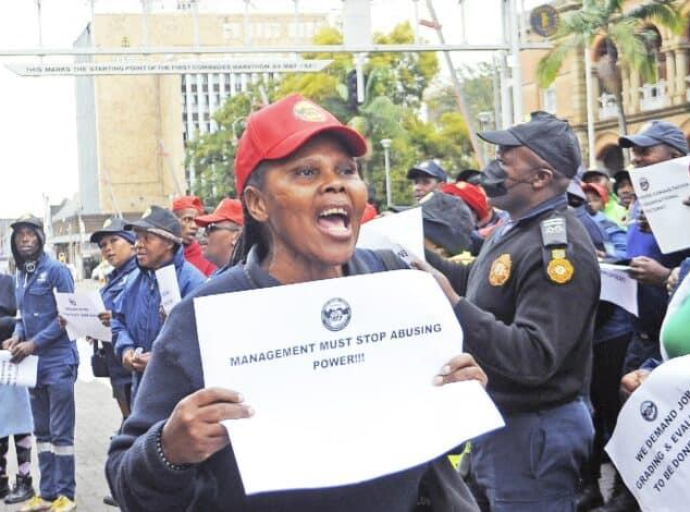
Labour intentions have escalated at Sol Plaatje Local Municipality in Kimberley, with contract workers protesting amid job cuts.
The South African Municipal Workers Union (SAMWU) is accusing the municipality of abandoning long-serving workers, while claims emerge that misinformation fuelled ongoing strike action in Kimberley
The workers staged protests outside the municipal offices in Ashburnham over the alleged termination of 137 fixed-term contract workers, whose contracts are expected to end on 29 May.
Today is the third day of the strike action that started last Friday. The protesting workers burned tyres and disrupted operations at municipal offices, preventing members of the public from entering the building.
Many of the affected workers have been employed in road maintenance and other essential municipal services and are now demanding permanent positions within the municipality.
SAMWU has vowed to intensify its fight against the planned terminations, arguing that long-serving workers are being unfairly discarded despite years of service to the municipality.
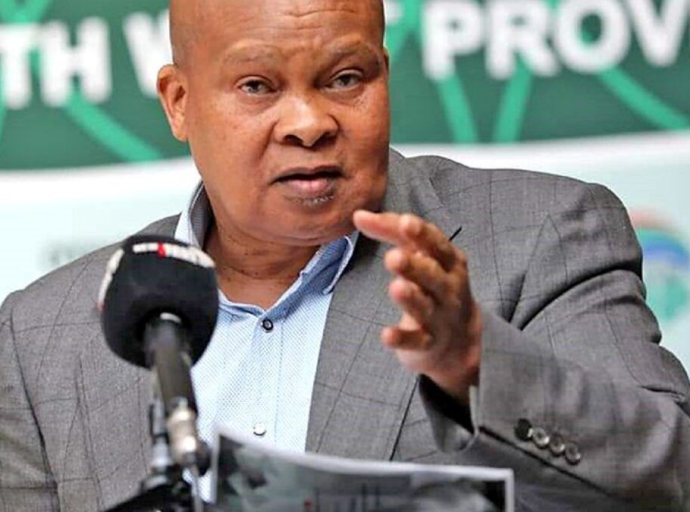
SAMWU Northern Cape Provincial Spokesperson, Papikie Mohale, says SAMWU will not stand by while workers who have dedicated years to keeping the city functioning are discarded without any job security.
“We are demanding that the municipality immediately stop these dismissals and engage with labour to find a lasting solution, he said.
Mohale also said workers remain deeply frustrated by the uncertainty surrounding their employment and warned that tensions could escalate further if no intervention is made.
Anonymous sources say the tensions have also been fuelled by misinformation circulating among workers regarding the status of the contracts and possible permanent appointments.
They say, despite these claims, uncertainty remains over whether management intends to review or reverse the termination notices.
Attempts to obtain comment from the Sol Plaatje Local Municipality were unsuccessful at the time of publication.
The death of struggle icon and former Premier of North West Kaobitsa ‘Bushy’ Maape has drawn tributes from political leaders and liberation veterans, marking the end of a life shaped by decades of activism, public service, and an unwavering commitment to education.
Maape died yesterday in Johannesburg after a short illness at 68.
For many in the province, Maape represented a generation of leaders forged in the struggle against apartheid. Long before he occupied the province’s highest office, he was an underground activist of the African National Congress, an operative of uMkhonto we Sizwe, and a political prisoner on Robben Island.
Maape served as premier from 2021 to 2024, a period during which he sought to stabilise governance in a province frequently under pressure due to service delivery and administrative challenges. Colleagues remember him as a measured, disciplined, and deeply committed leader who was deeply committed to ethical principles.
Premier Lazarus Kagiso Mokgosi described Maape as ethical and incorruptible, saying he consistently championed governance that put ordinary people first.
ANC spokesperson, Mahlengi Bhengu-Motsiri, said Maape’s life reflected the sacrifices of a generation that dedicated itself to freedom, democracy, and development in South Africa.
In a statement, his family remembers him as a warm and humble figure whose wisdom, kindness, and laughter left a lasting impression on all who knew him.
Memorial and funeral arrangements will be announced in the coming days.
After years of violence, lawlessness and mounting safety concerns at landfill sites, Mangaung Metropolitan Municipality has finally pulled the plug on scrap metal recycling and second-hand goods trading at all landfill sites across the metro.
The municipality confirmed this week that the sweeping ban follows growing concerns over criminal activity, weak enforcement of permit conditions and repeated violent incidents linked to scrap operations — including killings at some landfill sites.
In what is being viewed as one of the municipality’s toughest interventions yet, Mangaung said scrap metal recycling and second-hand goods trading will no longer be allowed at any landfill facility within its jurisdiction.
“The Municipality has resolved that scrap metal recycling and second-hand goods dealing will no longer be permitted at any landfill sites within the Mangaung Metropolitan area,” the municipality said in a statement.
For years, landfill sites across the metro have become flashpoints for illegal activity, with complaints ranging from theft, violence and turf wars to poor access control and unregulated trading.
The growing presence of scrap operations has often created dangerous conditions for waste reclaimers, municipal workers and nearby communities.
Municipal officials said the decision followed consultations with external departments and stakeholders as concerns escalated over public safety and operational control at landfill facilities.
Authorities believe the ban will help restore order at sites that have increasingly become difficult to regulate.
However, the decision does not solve the broader humanitarian and social challenges surrounding landfill sites.
Informal settlements continue to expand around several dumping grounds where families and waste reclaimers live in makeshift shelters under harsh conditions.
Many residents lack access to basic services such as clean water, sanitation and electricity.
Community leaders and residents have repeatedly warned that landfill sites have become centres of desperation driven by unemployment, poverty and limited housing opportunities.
Environmental health concerns have also been raised over unsafe living conditions and long-term exposure to waste.
Reacting to the municipality’s announcement, AfriForum’s Christo Groenewald welcomed the move but cautioned that enforcement would be critical.
He said authorities must also confront the issue of informal settlements surrounding landfill sites.
“Regulation without relocation and proper enforcement risks shifting the problem rather than solving it,” Groenewald said.
Mangaung has warned that reclaimers who fail to comply with the new directive could have their permits revoked and may be denied access to landfill sites as enforcement measures begin.
The municipality now faces pressure to ensure the ban delivers lasting change without deepening the hardship faced by vulnerable communities who depend on landfill activity for survival.
Modern society, as we know it, is bereft of social justice and fairness. We live comfortably in a world where nearly everything has a price i.e., water, land, education and even human attention. Yet, we suffer tall panic the moment a woman says “Nope, this one is not for free.” Suddenly, morality wakes up like a church elder who has just heard that popular Sister Bethina song at the nearby tavern.
For centuries, men have behaved as if they are the natural custodians of the female body. Almost as if the vagina is a public utility, like a municipal tap that must flow freely, especially for those who arrive with nothing but confidence and vibes. The idea that a woman can say, “access denied unless there is compensation,” shakes something deep in the patriarchal system. It disturbs an old, comfortable lie.
Our society generally has no problem with people using their bodies to make a living. In fact, that is exactly how the economy works.
The educated class sells brain power. The working class sells muscle. We all understand that survival under capitalism means converting parts of ourselves into value. But when women seek to derive a livelihood from their own bodies, suddenly the rules change.
We even buy water now, something many still call a gift from God. It falls from the sky, sustains life and belongs to no one. Yet we bottle it and sell it. Nobody is marching in the streets saying, “water must not be commodified”. We swipe our cards and move on.
But a woman cannot sell access to her own body?
That contradiction cannot be explained by morality alone. It must be located within the broader system of patriarchy and misogyny; a system that has always depended on controlling the female body and prescribing choices for it.
Patriarchy is not just about individual attitudes; it is an economic and social order. It assigns value unevenly. It decides whose labour counts, whose bodies are regulated and whose autonomy is negotiable. In a patriarchal society, the female body is treated as a site of control to be regulated through culture, religion, law and social expectation.
As Angela Davis reminds us, women’s unpaid labour has long been a foundation of economic systems. The home, often romanticised as a place of love, is also a site of extraction where cooking, cleaning, caregiving and emotional support are provided without wages. This is not incidental; it is structural.
Capitalism and patriarchy have worked hand in hand to naturalise women’s exploitation by making their labour appear as duty rather than work. If it is love, it need not be paid. If it is nature, it need not be questioned.
Bell Hooks was correct in insisting that patriarchy survives by normalising domination while disguising it as order. Women are expected to give, to nurture, to provide but not to set terms. Not to negotiate value. Not to withdraw.
This is where misogyny enters, not just as hatred of women but as punishment for women who refuse their assigned roles. A woman who complies is celebrated. A woman who resists is labelled immoral or deviant.
And so, the criminalisation and stigma around sex work are not isolated phenomena. They are extensions of a broader system that polices the autonomy of women. The issue is not simply the exchange of money for intimacy; it is the fact that women are asserting control over access to their bodies.
And that is intolerable in a system built on entitlement.
Because once a woman can say “this is mine and this is the price”, she disrupts the entire logic of patriarchy. She challenges the idea that men are entitled to access, whether through marriage, romance and/or economic dependency. She transforms what was assumed into something negotiated.
The discomfort with sex work is not really about sex. It is about power.
It is about a system that is comfortable commodifying everything, from water to wisdom, but draws the line when women claim ownership over their own bodies. It is about a society that allows men to sell their minds and muscles, but demands that women offer themselves within boundaries defined by others.
Until we confront patriarchy and misogyny at their root, until we accept that women are full agents capable of defining the terms of their own existence, this contradiction will stubbornly remain. And we will continue to live in a world where everything can be bought, except a woman’s right to decide her own value.
*Tshediso Mangope moonlights as a social commentator in his spare time and writes in his personal capacity…
**The views expressed do not necessarily reflect those of this publication (Journal News).
After years of rising concerns over crime, violence and illegal activity at landfill sites, Mangaung Metropolitan Municipality has finally moved to ban scrap metal recycling and second-hand goods trading across all landfill sites in the metro.
The municipality this week in a media statement confirmed that the decision was taken following several consultations, mounting concerns over safety risks, weak permit enforcement and escalating criminal activity linked to scrap metal operations.
Mangaung’s Themba Vryman said scrap metal dealing is increasingly being associated with violent incidents, which amongst others include killings at landfill sites which has prompted the outright prohibition of the activity.
“The Municipality has resolved that scrap metal recycling and second-hand goods dealing will no longer be permitted at any landfill sites within the Mangaung Metropolitan area,” he said.
The ban is being viewed as one of the metro’s strongest interventions yet to restore control at landfill sites that have long operated with limited regulation and growing informal activity.
“However, despite the decision, significant challenges remain on the ground. Informal settlements continue to expand around several landfill sites, where families and reclaimers live in makeshift structures under difficult conditions, often without access to basic services such as water, sanitation and electricity.
“Community safety and environmental health concerns have repeatedly been raised, with residents warning that enforcement alone will not resolve the deeper socio-economic pressures driving informal occupation of landfill spaces, Vryman said.
Reacting to the announcement, AfriForum’s Christo Groenewald said the decision was a step in the right direction but warned that implementation and enforcement would determine its success.
Groenewald says authorities must also address the broader issue of informal settlements at landfill sites, arguing that regulation without relocation and proper enforcement risks shifting the problem rather than solving it.
MMM has warned that reclaimers who fail to comply with the new directive may have their permits revoked and could be denied access to landfill sites as enforcement begins.


_thumbnail.jpg)


