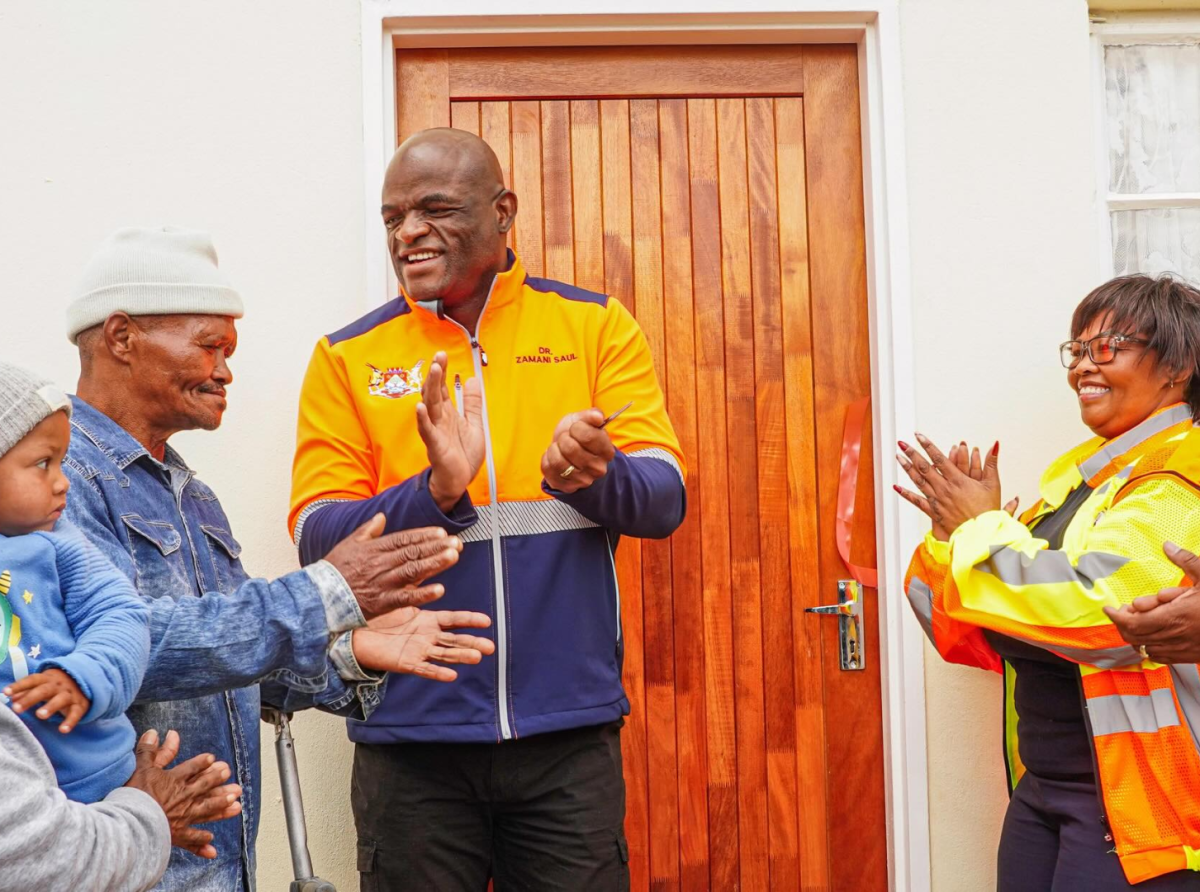
Northern Cape Premier, Dr Zamani Saul, is drawing national attention for measurable service delivery progress following the handover of 50 newly built homes under the Calvinia 200 Housing Project in Hantam Local Municipality.
Delivered alongside the Northern Cape Cooperative Governance, Human Settlements, and Traditional Affairs (Coghsta) MEC, Bentley Vass, the latest phase brings the completed total to 100 homes, with another 100 units expected to be finished by the end of 2026. The Calvinia project forms part of the province’s broader R1 billion housing programme aimed at reducing backlogs and restoring dignity in underserved communities.
At a time when many provinces continue to battle collapsing municipalities and financial instability, the Northern Cape is increasingly positioning itself around implementation-driven governance.
Beyond housing, the provincial government has expanded investment into roads, healthcare, water security, and renewable energy, treating youth development and solar energy initiatives as central pillars to stimulate local economic activity.
Saul has consistently linked these interventions to stronger governance systems and tighter municipal oversight. He recently confirmed a Section 139 intervention in Sol Plaatje Municipality as part of a 10-point turnaround strategy designed to restore administrative capacity and rebuild public confidence.
Saul also highlighted improved municipal financial performance across the province, noting that Northern Cape municipalities achieved an 87% expenditure rate on the Municipal Infrastructure Grant during the 2024/2025 financial year. According to Saul, this reflects marked improvements in local planning and implementation capacity.
During the recent Taking Parliament to the People programme hosted by the National Council of Provinces, Saul argued that South Africa is moving in the right direction under President Cyril Ramaphosa, particularly where coordinated interventions are used to stabilise struggling councils.
He stressed that turnaround plans are not simply about administrative recovery, but about rebuilding functional service delivery systems.
Political analyst, Sanet Solomon-Madonsela, a lecturer at the University of the Free State (UFS), believes the ANC in the Northern Cape has adopted a noticeably more responsive approach to infrastructure implementation. She points to large-scale developments across Kimberley and surrounding townships as visible examples of investment that have helped the party maintain political support.
According to Solomon-Madonsela, struggling provinces like the Free State and North West - which frequently rank among the country's weakest municipal performers in Auditor-General reports - could draw valuable lessons from this approach.
She notes that several Free State communities continue to consist largely of informal housing, highlighting the urgent need for improved planning. She argues that political parties strengthen themselves when they focus on governance and respond directly to community needs.
As construction continues on the remaining units, Saul’s administration continues to position itself around a delivery-driven agenda, turning policy commitments into visible change on the ground.
For residents in Calvinia, the housing development represents far more than governance reports or political targets. It stands as a visible sign of delivery, offering dignity, stability, and proof that government programmes can translate into meaningful improvements.