Free State Targets Surgical Backlogs
The three-day Cataract Marathon, held over the weekend at Boitumelo Regional Hospital in Kroonstad, was a great success, with over 100 patients receiving treatment.
Screening was conducted last week Friday with cataract operations scheduled for Saturday and Su...
Kamogelo Baukudi( 19) was collected by Daniel Malebatso in a Suzuki Ertiga at Martie du Plessis School to be dropped off at home on June 5. On their way home, Malebatso and the grade 11 pupil were stopped by a white Toyota Hilux GD-6 Double Cab alleging that the Suzuki is being used to deliver drugs.
Malebatso mentioned that two males wearing South African Police Service (SAPS) uniforms and the other wearing blue tracksuits. According to Malebatso, the Hilux has blue lights fitted on the grill and what seemed to be a police radio inside.It was then that the alleged police officer accused Malebatso of delivering drugs while separating Malebatso from Baukudi. The suspects instructed Daniel to drive at the front whilst they followed from behind to the Park Road Police Station.
Malebatso recalled that one of the two suspects spoke Sesotho fluently and mentioned the name “Thipe,” Both Malebatso and Baukudi’s phones were found under the bridge on Ferreira Road.
Lieutenant Colonel Thabo Covane has confirmed that a case docket of kidnapping and impersonating the police has been opened at Parkweg Police Station.
“Any member of the public who might have information that can help the police to find Kamogelo Baukudi; and might have seen the vehicles while in Vereeniging Drive is requested to contact Captain Sabata Jafta Moseme at 082 5262 713,” Covane concluded.
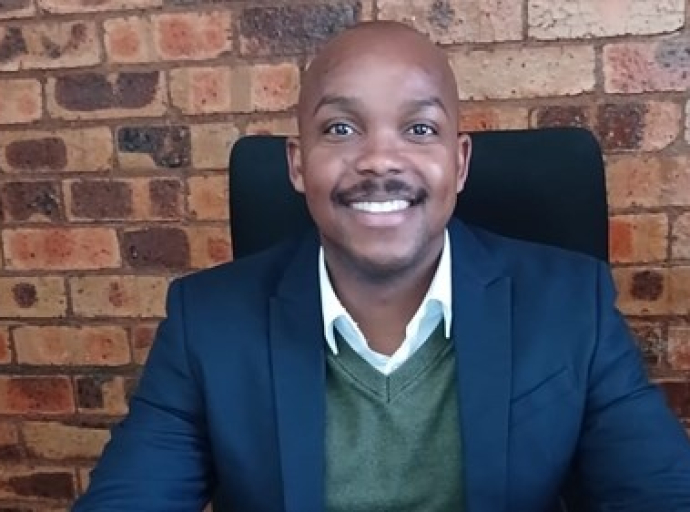
“You don’t need a title to lead, or a badge to care, just the courage to show up and the heart to make a difference,” said Northern Cape Constable Jeffrey Mopu.
In celebration of Youth Month, Northern Cape police have acknowledged one of their young officers.
Mopu (29) is based at the provincial Forensic Services office in Kimberley, where he works in the Decentralised Criminal Records and Crime Scene Management component. This unit oversees and supports nine LCRCs and one service point in Victoria West, serving as the Northern Cape’s main forensic support base.
“Const. Mopu and his office contribute to compiling crime scene files and preparing court-ready dockets within 24 hours,” said Northern Cape police spokesperson Sergio Kock. Despite limited resources and the vast geography from Springbok to Kuruman and Calvinia to De Aar, these small teams remain committed to excellence in service delivery.”
His journey in the police began in December 2023 at the visible policing unit in Pofadder, and he was transferred in June the following year to the Kimberley LCRC, where he worked with the Crime Information Management System.
The system is crucial for managing and storing information related to crime scenes and criminal records, ensuring that evidence is accurately recorded, monitored, and made available for use in court when necessary.
‘Mopu discovered how every crime scene has a story to tell’
That is where Mopu discovered how every crime scene has a story to tell. “If one has the patience to listen, the discipline to record, and the skill to interpret,” he said.
This year, Youth Month is commemorated under the theme “Skills for the Changing World – Empowering Youth for Meaningful Economic Participation”. One of the best examples of how young professionals can change society is Mopu, with his leadership that isn’t determined by position or title, with his commitment to community safety, and his passion for justice.
In addition to his police career, Mopu also holds a diploma in sound engineering and a certificate in project management.
The Gauteng Provincial Government has officially launched the pilot of its new licence plate system, which will run for six months before rolling out across the province.
The pilot project will start with the province’s g-Fleet Management vehicles and run for six month, putting the targeted ‘full launch’ at December 2025.
G-FleeT Management is a trading entity of the Gauteng Department of Roads and Transport and is a provider of vehicle leasing and fleet management services for the public sector in South Africa.
According to the province, the new plates make use of technological advancements that are aimed at tracking criminal activities, such as vehicle theft, fraud and cloning.
The new system will also assist the government with revenue collection, regulating the roadworthiness of vehicles and insurance.
It will also provide the province with data for planning and policymaking purposes and allow it to better manage the supply chain of plates.
This should create more accountability from manufacturers, particularly when it comes to illicit activity like plate cloning.
“The system is expected to strengthen the vehicle registration and law enforcement landscape, eradicating the use of cloned or fraudulent number plates and facilitating interoperability with SADC systems,” the province said.
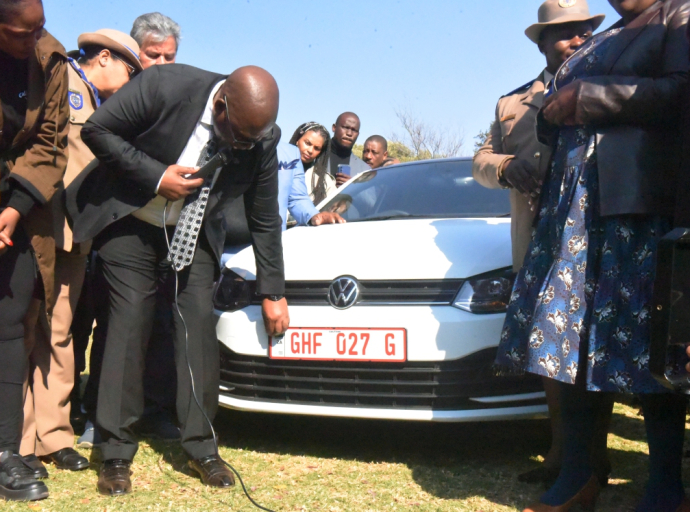
At the launch of the pilot at Nasrec, the Gauteng government revealed the design of the new plates as well as the new features.
As previously reported, the new “smart” plates come with embedded QR codes with track and trace features that will be used for identification and registration.
They will also have a ‘tamper-evident’ security decal affixed to them to enhance anti-counterfeiting measures.
The province has dropped the current blue colouring and presence of the Gauteng coat of arms for the standard plates, instead using a default black and white colouring.
However, there are several different colour schemes, depending on the type of vehcile. For example, military vehicles and diplomatic vehicles. The g-Fleet trial will follow the new formatting in red.
Each plate will also feature the South African flag and the UN country code.
Speaking at the launch of the pilot, Gauteng Premier Panyaza Lesufi said that in addition to the new technology being implemented to combat crime, the new plates were also an opportunity to revise registrations.
He said that the current formatting (AA 11 AA GP) was running out of combinations, similar to the previous format (AAA 111 GP).
The new system is digital, with each registration getting a unique ID. “We said, let’s take advantage of the migration and create a new digital system,” he said.
Regarding pricing, this is not yet clear. Various stakeholders have raised concerns that the migration will costly to road users and fleets—who have to get new plates and pay for registration.
Groups like Outa have warned that if it proves to be too expensive, many national fleets would opt to register outside the province, actually costing it revenue.
During the unveiling, MEC for transport Kedibone Diale-Tlabela explained some of the new security features and how they would help prevent instances of bribery and corruption.
She implied that the new features and benefits outweighed the cost.
“This is a great idea, please get your new numbers plates. Don’t ask me about the price, just go and do it,” she said.
The combination of a reduced supply of beef, the ban on Brazilian chicken imports, and the collapse of chicken producer DayBreak Foods could make meat much more expensive in South Africa.
This is the warning from Arnold Prinsloo, the CEO of Eskort, one of South Africa’s biggest meat manufacturers, who highlighted the looming food security crisis.
Prinsloo raised the alarm over what he calls a “perfect storm” for food security, as several events could push the cost of meat beyond the reach of millions.
Firstly, a new case of foot-and-mouth disease has been confirmed at a Gauteng feedlot owned by Karan Beef, the country’s largest beef producer.
The facility has been placed under quarantine, and slaughter volumes have already been slashed by nearly 75%.
According to Prinsloo, the disruption could have serious implications for supply and pricing. “If the quarantine is prolonged or the disease spreads, it is possible that the beef supply will contract and prices will rise,” he warned.
Another issue is the recent ban on chicken imports from Brazil, imposed due to an outbreak of avian flu in that country, which is already straining local production.
Brazil is South Africa’s primary source of mechanically deboned meat (MDM), an essential raw ingredient in low-cost processed meats like polony and Viennas.
“Some smaller producers have already run out of raw material since the import ban was imposed on 15 May,” Prinsloo said. “This ban alone will impact 400 million low-cost meals per month.”
Compounding the issue is the financial collapse of Daybreak Foods, one of South Africa’s largest integrated poultry producers.
The company has entered business rescue and recently had to cull 350,000 chicks due to feed shortages.
Prinsloo added that the crisis at Daybreak will only tighten the squeeze on local chicken supplies and put further pressure on prices.
“We’re facing a situation where meat is going to be more expensive for everyone this winter, but the poorest households will also face hunger and malnutrition,” Prinsloo said.
The situation is urgent
While some in the poultry industry have downplayed the situation, claiming there’s no imminent shortage, Prinsloo argued that the reality on the ground tells a different story.
“South Africa imports 19,000 tonnes of MDM every month from Brazil, while local producers can only supply 100 tonnes,” he explained.
“It is disingenuous to suggest that this won’t affect food security. The people who suffer most are those with the fewest affordable choices and the least ability to make their voices heard.”
Prinsloo has joined industry bodies such as the Association of Meat Importers and Exporters (AMIE) and the South African Meat Processors Association in calling Minister of Agriculture John Steenhuisen to intervene.
He’s urging the government to narrow the Brazilian import ban to the specific state affected by avian flu rather than imposing it on the entire country.
“This will allow trade from unaffected regions of Brazil to continue, preserving supply chains, protecting public health and safeguarding thousands of jobs at meat processors,” he said.
The situation is already having a visible impact. AMIE reports that the price of mechanically deboned chicken has surged by 140% since the ban.
According to Prinsloo, that’s an early warning of a broader food emergency. “The most vulnerable consumers are already being priced out of the market,” he said.
“Every day that goes by with no imports is another nail in the coffin of food security for millions of South Africans.”
Prinsloo stressed that urgent, coordinated action is needed to prevent a full-blown food crisis.
“This triple threat to our meat supply—disease, disrupted imports, and domestic production failures—demands immediate attention,” he said.
“We cannot afford to wait until supermarket shelves are empty and prices skyrocket. The time to act is now.”
US President Donald Trump on June 4, 2025 announced a ban on visas for foreign students who are set to begin attending Harvard University, ramping up his administration's crackdown on higher education.
A court this week put a temporary stay on Donald Trump's latest effort to stop foreign students from enrolling at Harvard, as the US president's battle with one of the world's most prestigious universities intensified.
A proclamation issued by the White House late Wednesday sought to bar most new international students at Harvard from entering the country, and said existing foreign enrollees risked having their visas terminated.
"Harvard's conduct has rendered it an unsuitable destination for foreign students and researchers," the order said.
Harvard quickly amended an existing complaint filed in federal court, saying: "This is not the Administration's first attempt to sever Harvard from its international students."
"(It) is part of a concerted and escalating campaign of retaliation by the government in clear retribution for Harvard's exercising its First Amendment rights to reject the government's demands to control Harvard's governance, curriculum, and the 'ideology' of its faculty and students."
US District Judge Allison Burroughs on Thursday ruled the government cannot enforce Trump’s proclamation.
Harvard had showed, she said, that without a temporary restraining order, it risked sustaining "immediate and irreparable injury before there is an opportunity to hear from all parties."
The same judge had already blocked Trump's earlier effort to bar international students from enrolling at the storied university.
Government vendetta
The government already cut around $3.2 billion of federal grants and contracts benefiting Harvard and pledged to exclude the Cambridge, Massachusetts, institution from any future federal funding.
Harvard has been at the forefront of Trump's campaign against top universities after it defied his calls to submit to oversight of its curriculum, staffing, student recruitment and "viewpoint diversity."
Trump has also singled out international students at Harvard, who accounted for 27 percent of total enrollment in the 2024-2025 academic year and are a major source of income.
In its filing, Harvard acknowledged that Trump had the authority to bar an entire class of aliens if it was deemed to be in the public interest, but stressed that was not the case in this action.
"The President's actions thus are not undertaken to protect the 'interests of the United States' but instead to pursue a government vendetta against Harvard," it said.
Since returning to office Trump has targeted elite US universities which he and his allies accuse of being hotbeds of anti-Semitism, liberal bias and "woke" ideology.
Trump's education secretary also threatened on Wednesday to strip Columbia University of its accreditation.
The Republican has targeted the New York Ivy League institution for allegedly ignoring harassment of Jewish students, throwing all of its federal funding into doubt.
Unlike Harvard, several top institutions -- including Columbia -- have already bowed to far-reaching demands from the Trump administration.
A Durban woman who was arrested at King Shaka International Airport and detained in a cell described as 'dirty' and containing faeces for a week due to mistaken identity has been awarded R580,000 in damages.
This comes after the woman, Cynthia Khedama successfully sought relief at the Supreme Court of Appeal appealed against a judgment which had ordered police Minister Senzo Mchunu to pay her R350,000 after she was wrongfully arrested and held for 12 days.
The amount was initially R1 million, however, Mchunu appealed, and the amount was then set at R350,000.
On December 3, 2011, Khedama, who was 30 at the time and worked as a sales manager for a local fashion firm, was on her way to Turkey with her employer and his wife when she was stopped by police.
She was seated in the international departures lounge when she was approached by two police officers who took her to a room and questioned her about two hours regarding her journey.
After not being satisfied with her answers, they told her that she was going to be arrested. They took her suitcase and opened it in full view of the public and her belongings were scattered on the floor.
To Khedama, this was very embarrassing. She explained that she urged the police to contact an officer in Cape Town who had previously spoken to her regarding fraud allegations after she had lost her identity document.
Even after the police confirmed with the officer, they still detained her.
However, she was allowed to make a call to her boyfriend who had to come and collect her suitcases.
When the boyfriend arrived, he tried to talk to the police, and they hurled insults at Khedama for dating a Kwerekwere- a derogatory term used to describe foreign nationals.
She was then taken to Tongaat Police Station in the back of a police van.
Upon her arrival, she was escorted to a small, dirty cell with faeces present, emitting a foul odour. Additionally, there was a filthy grey blanket on the floor, but she had no blanket to cover herself.
She said she was kept there from December 3 until December 9, 2011.
After a week, she was transferred to Cape Town where her fingerprints were taken, and it was proved that she was not the person they were looking for.
Despite fingerprints proving her innocence, Khedama was kept for another night. The following day, she was taken to the Philippi Magistrates’ Court where she was granted R500 bail on December 12.
She was assisted by her boyfriend to fly back to Durban.
Charges were finally withdrawn in March 2012 when it was clear she was not the person sought by police.
In 2013, she sought legal redress and sued the police minister.
During the appeal, acting Judge Daniel Vuminkosi Dlodlo acknowledged the lasting damage Khedama endured, not just psychologically, but also professionally, as she lost her seniority status at work and faced tarnished reputation.
"Instead of enjoying protection, she suffered in a cruel manner at the hands of the police during arrest and subsequent thereto. The appalling conditions she experienced as a detainee only served to exacerbate the bad treatment meted out to her by the police members," said judge Dlodlo.
"I am of the view that the amount of damages awarded by the full court must be revisited and set aside in order to be replaced with what is a fair amount. The fair amount of damages is the sum of R580,000." added the judge.
The judge ordered the amount to be paid with interest.