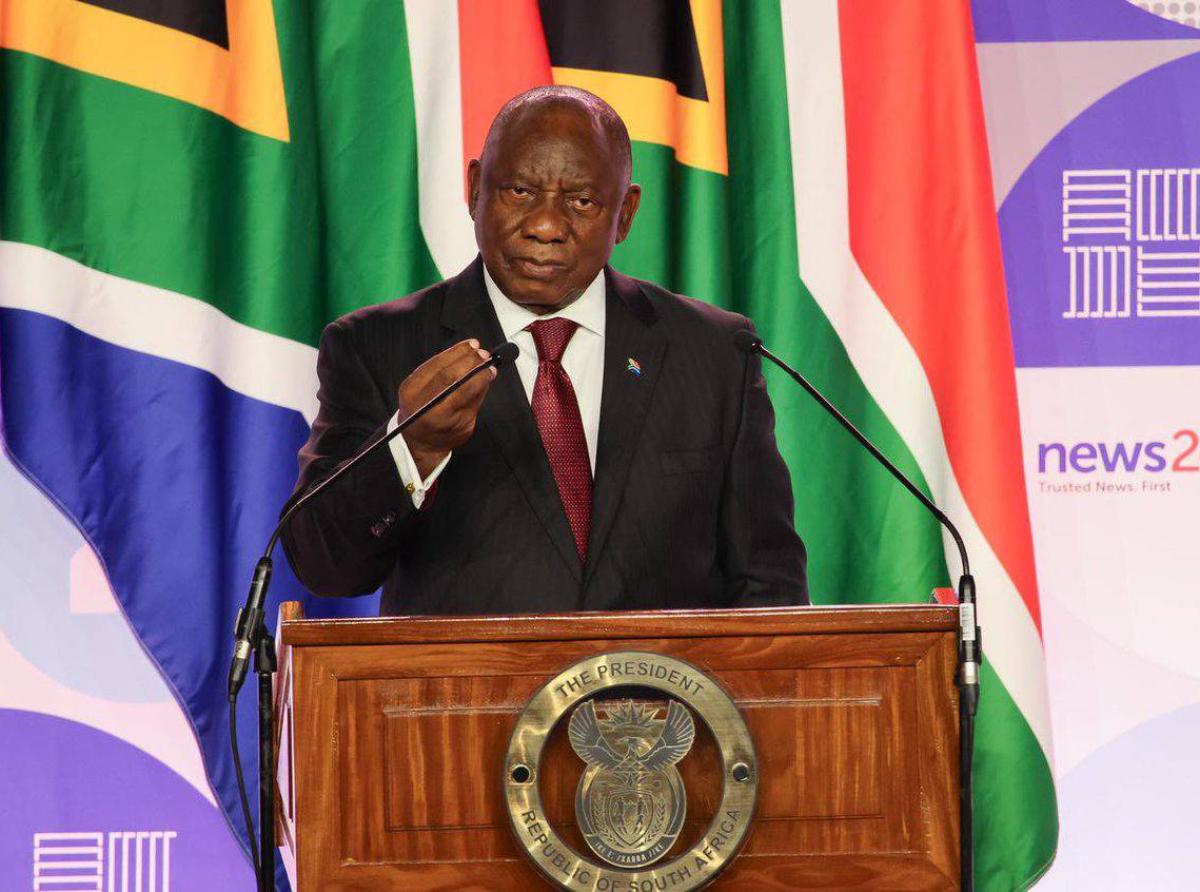
President Cyril Ramaphosa says the government will invest more than R1 trillion over the next three years to modernise and expand South Africa’s public infrastructure.
Speaking at the Sixth South Africa Investment Conference on Tuesday, he said the investment would cover roads, rail, ports, water, energy, and digital projects.
“Over the next three years, the state has budgeted to invest more than R1 trillion or approximately USD 58 billion in modernising and expanding public infrastructure across South Africa,” Ramaphosa said.
He emphasised that R940 billion of the allocation is planned for infrastructure spending, with R375 billion set aside for state-owned companies to maintain, upgrade, and expand their assets.
Highlighting the road network, Ramaphosa said the South African National Roads Agency (SANRAL) would be investing between R300 billion and R400 billion to upgrade and maintain national roads and develop strategic freight corridors.
“Up to R250 billion is being invested in ports and logistics modernisation, driven by Transnet. The Port of Durban is being expanded to handle higher container volumes and improve efficiency, with similar upgrades in Cape Town and Ngqura,” he added.
Passenger rail will also receive significant attention, with about R420 billion allocated to the Passenger Rail Agency of South Africa for corridor reconstruction and rolling stock programmes, as well as to Transnet for network expansion.
Ramaphosa said the water sector would see major investment as well, including projects such as the Olifants Management Model Programme in Limpopo and the uMkhomazi Dam linked to Phase 2 of the Lesotho Highlands Water Project.
He also said energy infrastructure will receive R6.5 billion over the next three years, supporting the Department of Energy’s long-term energy security plans. Other projects include upgrades to OR Tambo International Airport, investments in green logistics, and incentives for electric vehicle infrastructure.
The President singled out the R5 billion investment in the Square Kilometre Array (SKA) radio telescope in the Karoo, which will see the construction of two supercomputers that he said will rank among the fastest in the world.
“This isn’t just a testament to the value of strategic public investment in digital infrastructure; it is also a reflection of South African scientific excellence and world-class scientific research output,” he said.
Ramaphosa also stressed the role of innovative financing in fast-tracking infrastructure development.
“We will be utilising innovative funding models that will reduce risk and attract investors to fast-track infrastructure projects. One of these is the Infrastructure Fund that we established in 2018 out of the need to deploy blended finance to infrastructure development,” he said.
Last year, the fund approved projects worth about R38 billion across water, sanitation, student accommodation, health, energy, and transport.
He added that public-private partnership regulations and instruments such as the Credit Guarantee Vehicle would further de-risk private investment.
Economic transformation and empowerment remained a central theme in his address. “The transformation of our economy is necessary to drive sustained growth, reduce inequality and correct the injustices of the past.
''We are undertaking a review to refine, realign and strengthen our B-BBEE framework to ensure that it supports transformation while at the same time enabling investment and growth,” he said.
Ramaphosa also described South Africa’s empowerment laws as “practical and innovative,” highlighting the Equity Equivalent Investment Programme (EEIP) for multinational companies unable to comply with local B-BBEE ownership requirements.
“Since its inception, the EEIP has onboarded some of the world’s leading multinational firms who have leveraged the programme to direct investment into local development, to incubate black, youth and women-owned businesses, and to fund skills development,” he said.
“Our overriding objective is to support firms with compliance, and to embrace empowerment as a meaningful investment in South African’s long-term economic stability.”
*This article was first published by EWN