By Bernell Simons
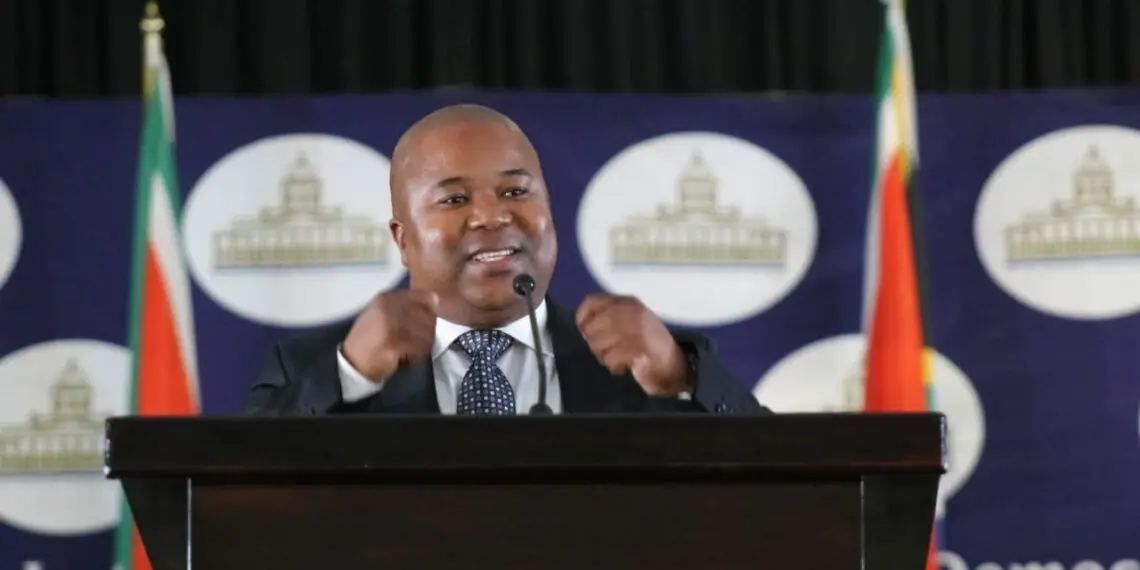
Free State Human Settlements MEC Saki Mokoena has unveiled a R1.18 billion plan to fix chronic housing delays, placing a strict “Beke le Beke” week-by-week monitoring system at the centre of efforts to fast-track delivery, tighten accountability, and restore dignity in struggling communities.
Tabling the department’s 2026/27 budget, Mokoena framed the approach as a decisive shift from years of inefficiencies, stalled projects, and weak oversight. The department, he said, is now focused on rebuilding state capacity and ensuring that both officials and contractors deliver consistently and on time.
At the core of this shift is the “Beke le Beke” model—meaning “week by week”—which introduces continuous monitoring of housing projects, informal settlement upgrades, and municipal performance, replacing slow and often ineffective reporting cycles.
The department’s R1.189 billion allocation reflects a 7.1% decrease from the previous financial year, largely due to national fiscal pressures and reduced conditional grants. The Human Settlements Development Grant has been cut to R777.1 million, while the Informal Settlements Upgrading Partnership Grant drops to R112.8 million. Despite these reductions, Mokoena insists delivery will be accelerated through tighter coordination and improved implementation.
A key priority is the replacement of ageing two-roomed houses with Breaking New Ground (BNG) units. R30 million has been allocated for projects in Ipopeng (Fauriesmith), Dark City (Mangaung), Bronville (Matjhabeng), and Extension 2 (Dihlabeng). An additional R2.567 million has been set aside under the Expanded Public Works Programme to support skills development in trades such as plumbing and plastering, aimed at boosting employment while improving construction quality.
Performance in the past financial year has been mixed. The department delivered 1,816 serviced sites in greenfield developments and exceeded informal settlement upgrading targets, completing 2,873 sites against a target of 1,062. However, BNG housing construction lagged, with only 41.5% of the 1,663-unit target achieved. In response, contractor panels have been reopened to expand capacity and improve delivery.
Infrastructure upgrades remain central to the strategy. In Hani Park, 261 houses have been connected to water and sewer systems, with full completion expected once pump station upgrades are finalised. In Nala Municipality, 97% of a 429-site bulk services project has been completed. In Matjhabeng, additional sites have been allocated in Nyakallong to relocate households affected by mine water risks.
Progress is also being made in Community Residential Units, with 270 units completed at G-Hostel and 130 units ready for occupation in Mangaung’s Dark and Silver City, pending bulk service connections.
Large-scale catalytic projects are driving spatial transformation across the province. In Bethlehem, the Bakenpark Integrated Development is back on track with new contractors and 90 BNG houses already under construction. In Sasolburg, the Vaal River City project is advancing, with thousands of serviced sites nearing completion. In Moqhaka, most of the planned 5,300 residential sites already have water and sewer connections, with alternative bulk infrastructure solutions being explored to accelerate the remaining work.
The province continues to face a significant informal settlement challenge, with 189 settlements housing more than 84,000 households. Mokoena said the department is prioritising in-situ upgrading while identifying relocation sites where necessary. He cautioned against objections that delay development, warning that housing delivery must not be stalled by administrative or politically driven resistance.
Restoring ownership and dignity remains a key focus. The department has already registered 1,319 title deeds and is working to ensure every completed house is transferred with full ownership documentation. This includes converting old permits and deed grants into formal title deeds, particularly for historically disadvantaged groups.
Mokoena also outlined institutional reforms aimed at decentralising decision-making to the district level while strengthening oversight and accountability. He acknowledged ongoing challenges, including corruption, procurement irregularities, and capacity constraints, but said corrective measures are being implemented.
Closing his address, Mokoena made it clear that the department’s direction is firmly set—faster delivery, stricter oversight, and a housing programme that not only builds homes but restores dignity and begins to reshape spatial inequality across the Free State.