Free State Targets Surgical Backlogs
The three-day Cataract Marathon, held over the weekend at Boitumelo Regional Hospital in Kroonstad, was a great success, with over 100 patients receiving treatment.
Screening was conducted last week Friday with cataract operations scheduled for Saturday and Su...
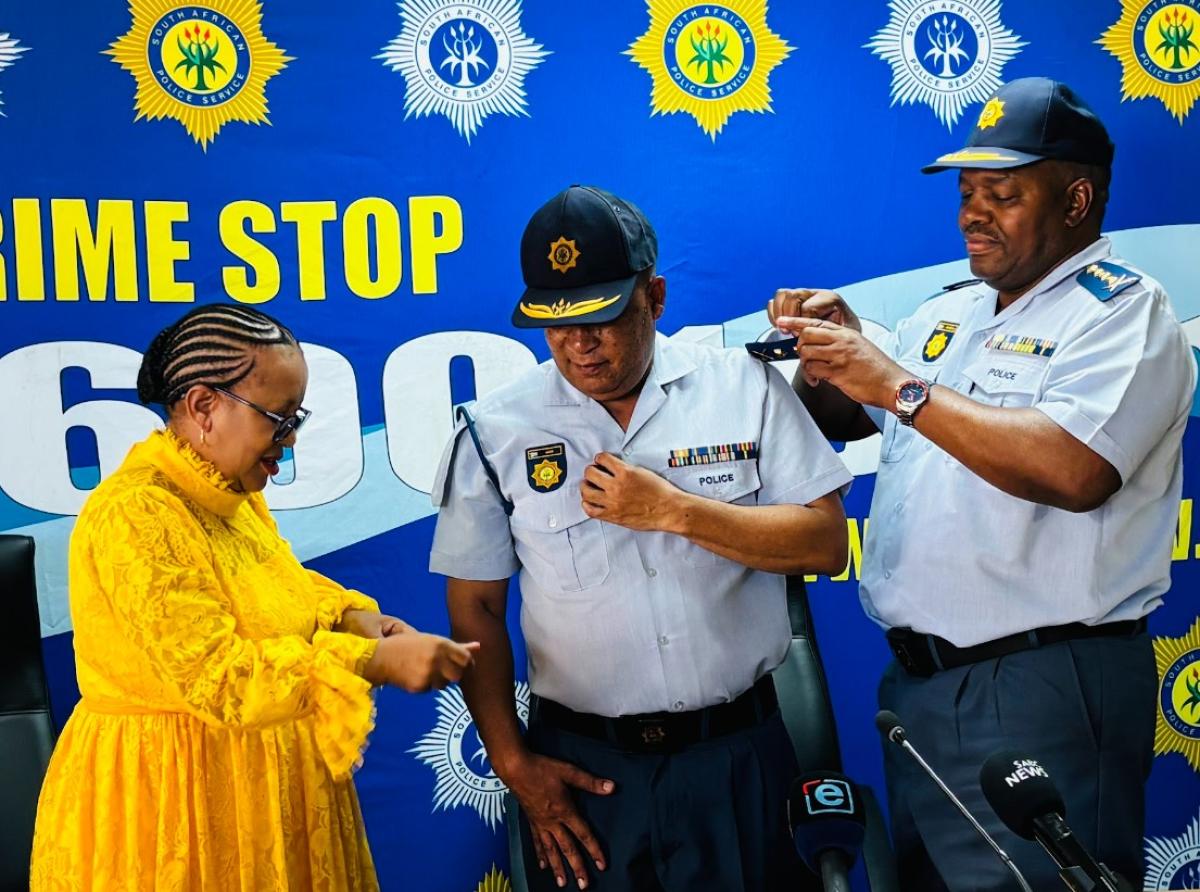
Former Free State Deputy Provincial Commissioner, Thabang Lesia takes the helm as Provincial Commissioner. Picture: Bernell Simons
By: Bernell Simmons
New Free State Top Cop Vows Zero-Tolerance on Corruption, Pledges Accountability and Trust Rebuild.
Newly appointed Free State Provincial Com missioner, Lieutenant General Thabang Lesia, has drawn a hard line in the sand— vowing to root out corruption and restore integrity within the South African Police Service (SAPS) as he moves to rebuild trust between communities and the men and women in blue. Following his promotion by National Commis sioner Fannie Masemola on Monday, Lesia signalled a zero-tolerance approach to misconduct, warning that rogue officers will be held accountable while internal oversight and discipline are strengthened. He maintains that restoring public confidence will depend on visible policing, ethical leadership and consistent engagement with communities across the province. Masemola expressed full confidence in Lesia’s ability to steer the organisation through a turbulent period marked by heightened public scrutiny, par t icularly in the wake of the Madlanga Commission and ongoing engagements within Parliament’s ad hoc committee. in the organisation. However, given your experi ence, your credentials and your deep understand ing of both operational and investigative policing, I have full confidence in your ability to lead the SAPS in this province,” said Masemola. “With your experience as both a seasoned detec t ive and an accomplished operational commander, I am confident in your ability to provide strong stra tegic direction and sound judgment—particularly at a time when crime patterns are evolving and organised crime continues to intensify. The SAPS is navigating a challenging period in terms of public perception. You have followed developments aris ing from the Madlanga Commission and engage ments within the Parliament ad hoc committee. You have felt the weight of public scrutiny—some of it fair, some of it brutal—but all of it significant.” Free State Premier MaQueen Letsoha-Mathae be lieves will work in his favour. Yet, even as Lesia positions himself as a reformer, his appointment is not without controversy. His ten ure as Deputy Provincial Commissioner was cloud ed by allegations of corruption and misconduct raised by whistle-blower Patricia Morgan-Mashale, adding complexity to his leadership profile and rais ing broader questions about accountability within SAPS. Lesia has consistently denied the allegations, describing them in court as fabricated. In 2021, he secured an interim protection order against Mor gan-Mashale and her husband following claims of harassment and defamation. On Monday, however, Lesia struck a firm tone on accountability. “There is no way we cannot have managers, especially at the senior level, who are not accounting for what they’ve been hired to do,” he said. His remarks carry particular weight in a province where leadership failures—both political and ad ministrative—have often gone unchecked, eroding public confidence in institutions meant to serve and protect. Outlining his priorities, Lesia emphasised the need to improve police visibility, service delivery and internal conduct. He made it clear that indiscipline within the ranks would not be tolerated. “We will improve visibility, improve service, and address the conduct of the police,” he said. “We are not going to allow officers to do as they please. Our focus will be on tackling drugs, gang violence, organised crime and corruption—but our biggest ongoing battle remains the spread of drugs in our communities.” With 39 years of service, having joined SAPS as a student constable in 1986, Lesia brings decades of institutional experience to the role—something “I know him… he has been in the system. He is not a new person,” she said, expressing confidence that he “will not disappoint.” But the Premier’s support also underscores a broader reality: policing alone cannot solve the province’s crime challenges. “We need the involvement of communities,” she said. “Police cannot be everywhere.” Ultimately, Lesia’s success will hinge not only on his promises, but on his ability to act decisively and consistently in a system long criticised for failing to hold its own accountable. In a climate of deep scep t icism and rising crime, his leadership will be tested not by rhetoric, but by results. Whether he can truly clean up SAPS in the Free State remains to be seen—but the expectation is clear: the era of impunity must come to an end.