By: Tshediso Mangope
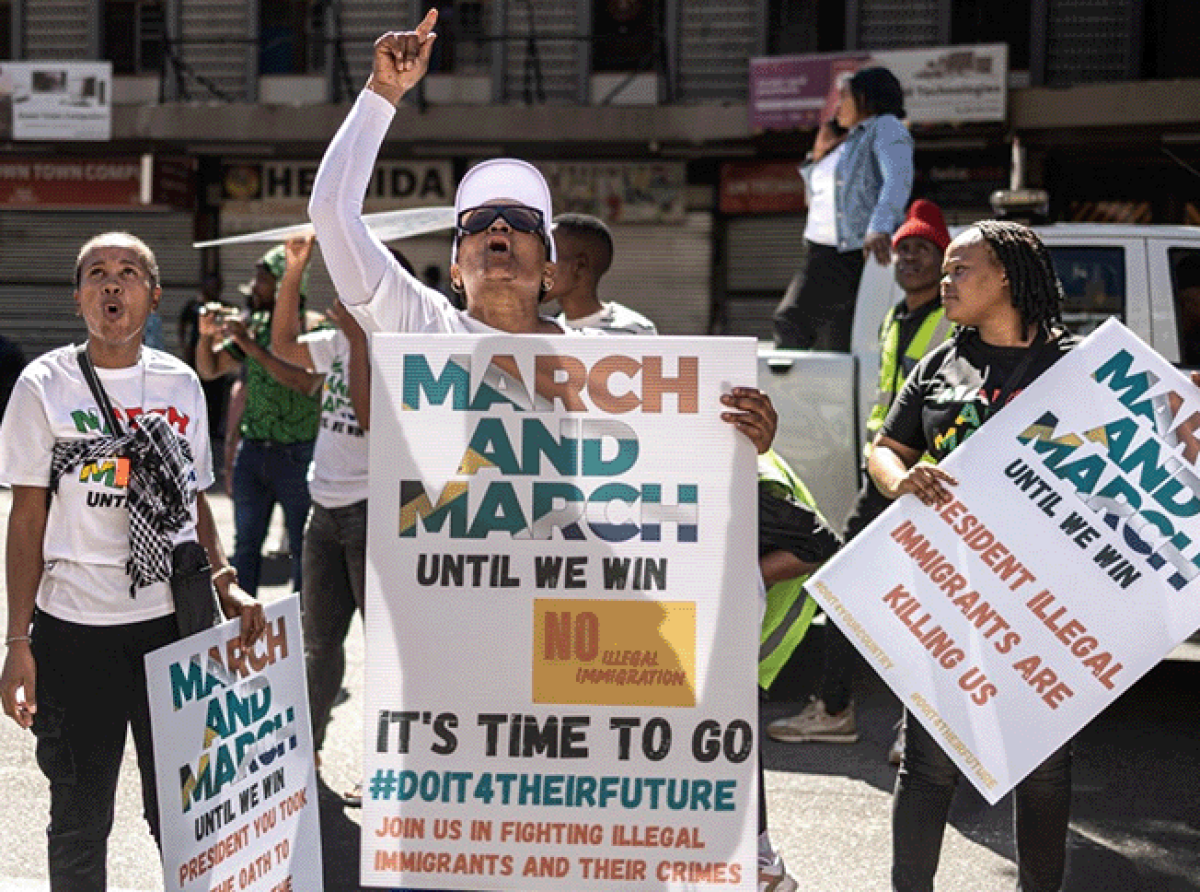
A growing number of South Africans are mobilising in open defiance of what they see as a failed migration system. This wave of activism, associated with problematic figures like Ngizwe Mchunu, is not emerging in a vacuum. It is a signal that ordinary South Africans have lost faith in the ability of our government to enforce migration laws and protect communities from acts of criminality linked to undocumented immigrants.
And then comes the story of Mazwi Kubheka, a 27-year-old South African businessman from Vosloorus who was abducted after refusing to submit to intimidation linked to spaza shop networks controlled by foreign nationals. This is a flashing red light. It tells us that the law has gone missing and something far more dangerous is taking place.
Kubheka is not alone. Xolani Lamani, another South African businessman from Orange Farm, watched his supermarket go up in flames after receiving endless threats allegedly linked to the same ecosystem. These are not isolated incidents of crime; they point to a pattern of intimidation and mutilation of South Africans by foreign nationals.
Now, this movement led by Ngizwe presents us with yet another opportunity to deal with the issue of illegal immigrants without pretending that complexity does not exist.
Perhaps the starting point is to acknowledge that not all migrants are a problem. Many come here legally, work hard, contribute to communities and respect South African laws. They are not the target of frustration, nor should they be. The real problem begins when people enter the country illegally and operate outside the framework of the law. That is where the line must be drawn without apology.
Because once the first law is broken at the border, it becomes much harder to enforce the rest. This is not about hatred. It is about governance.
Since 2008, when the first eruption happened, a tendency has arisen to shut down any concern about undocumented foreign nationals by shouting “xenophobia”. Quite frankly, this is intellectually lazy and dastardly dishonest.
Every country has immigration laws and expects those laws to be respected. South Africa cannot be the only country where asking for compliance with the rule of law is treated as a moral failure. Insisting that people must enter, live and trade legally in this country is not xenophobia. It is the most basic function of a sovereign state.
What is often conveniently ignored is who bears the real cost of a poorly managed migration system. It is not we people who live in gated estates. It is not people who use private healthcare, take their kids to private schools, and enjoy a comfortable distance from the township where the real impact is. No, the pressure is felt by the working class and the poor; people who stand in long queues at public hospitals, fight for space in already overcrowded schools and struggle to find economic footholds because they compete with undocumented foreign nationals.
It is easy to preach open borders when your children will never sit in a classroom of 60 learners. It is easy to speak of “African unity” when you will never have to compete for a basic job opportunity and/or access to public healthcare. For many of us, the consequences are only theoretical.
Unbelieving Thomases must visit communities that sit along the border with Lesotho. There, the conversation is not about ideology but survival. Families wake up to find their livestock gone overnight, and everything vanished without a trace. These are livelihoods and dignity wiped out in a single night by the cruelty of a failing migration system that privileges foreign nationals over South Africans.
The border, in these instances, becomes less of a line of control and more of a corridor of escape for unflinching foreign nationals. No wonder our communities are starting to feel exposed, abandoned and unheard. It is difficult to preach patience and process to a family that has lost everything and sees no consequence for those responsible.
Where the argument goes wrong is when we confuse the moral history of African solidarity with the present-day responsibility of governance.
Yes, South Africa benefited from widespread support during the liberation struggle against the repugnant system of apartheid. Yes, our freedom fighters were trained in different parts of the African continent. But that was a political and military context, shaped by deliberate decisions of governments and liberation movements. It was not an open invitation for lawlessness in a democratic South Africa.
Gratitude does not cancel governance. Solidarity does not replace the rule of law.
There is no widespread pattern of South Africans entering other African countries, dominating informal retail sectors, and displacing locals in the same way tensions are now emerging in most of our communities. South Africans are not in the habit of selling drugs and turning young girls into prostitutes, hijacking buildings and running widespread criminal networks in other countries.
Yes, we must resist the temptation to paint all foreign nationals with one brush. But refusing to generalise does not mean we must refuse to act. The state has a responsibility to enforce immigration laws, secure our borders, regulate economic activity and dismantle criminal networks led by foreign nationals.
Right now, that responsibility is not being met with the urgency the situation demands. And when the state fails, charlatans like Ngizwe will find a gap to respond in ways that are dangerous, uncontrolled and unjust.
That is the real risk we face.
South Africa does not need inebriated arguments dressed up in Pan-Africanist and Black Consciousness discourse. We need a functioning system that welcomes those who come here legally and respect the laws of our country.
In the end, this is not about South Africans versus foreign nationals.
It is about whether the law means anything at all.
*Tshediso Mangope moonlights as a social commentator in his spare time and writes in his personal capacity…
**The views expressed do not necessarily reflect those of this publication (Journal News).